July 26, 2026
What Is an AEO Prompt? A Practical Guide for Marketers
Learn what an AEO prompt is, how it differs from SEO and GEO, and how to use prompt tracking to improve AI search visibility.
Search behaviour is moving beyond keywords. By May 2026, Google AI Overviews had reached more than 2.5 billion monthly users, while AI Mode had surpassed 1 billion, with queries more than doubling every quarter. AI-referred visitors also show strong commercial intent. Adobe found that AI-referred retail traffic converted 42% better than non-AI traffic in March 2026.
Your target audience now ask AI tools to complete questions, compare options and receive answers that can shape their decisions before they visit a website. For marketing and content teams, this creates a new visibility challenge. It is no longer enough to know which keywords you rank for. You also need to understand which AEO prompts your audience uses, whether your brand appears in the response and how AI describes it.
This blog explains what an AEO prompt is, how AEO differs from SEO and GEO, and how prompt monitoring can turn AI search demand into measurable content decisions.
What is an AEO prompt?
An AEO prompt is a question or request that someone enters into an AI platform. For marketers, it can be tracked as a unit of demand to understand what your target audience want to know and whether a brand appears in the resulting answer.
AEO stands for Answer Engine Optimisation. It focuses on helping brands appear in answers generated by platforms such as ChatGPT, Perplexity, Gemini and Google AI Overviews.
Traditional SEO targets keywords entered into a search engine. AEO focuses on the fuller, more conversational questions people ask AI.
For example, a keyword might be “project management software”. An AEO prompt could be “What is the best project management tool for a small remote team?”
The difference matters because AI evaluates the complete question, draws on sources it considers relevant and produces a composed response. Only a small number of brands may be mentioned or cited in that answer.
An AEO prompt is therefore worth tracking when two conditions are met: your target audience are likely to ask it, and appearing in the answer could influence their shortlist or next action. Treating prompts as a unit of demand gives marketing teams a practical starting point for measuring AI search visibility.
You may also see this field described as AI search engine optimisation, Generative Engine Optimisation or AIO, meaning AI Optimisation. The terminology varies, but the underlying goal is similar: understand what your target audience ask AI and improve your brand’s presence in the answers.
AEO vs SEO and how they differ
AEO and SEO are related disciplines. The clearest way to understand the difference is to compare what each one optimises and where the result appears.
SEO improves how a page ranks when someone searches. The result is usually a list of links, allowing the user to decide which pages to visit. A page can rank below the top position and still earn valuable traffic.
AEO focuses on visibility within the answer itself. When an AI platform responds to a prompt, it may mention only a few brands or sources. If your brand is missing, the buyer may complete part of their research without encountering it at all.
The two disciplines share important foundations. Clear structure, genuine expertise, factual accuracy and authoritative sources can support both search rankings and AI citations.
AEO adds another layer of measurement. It asks whether AI platforms can understand your content, trust its claims and use it when answering relevant prompts. For this reason, AEO should complement SEO rather than replace it.
AEO vs GEO and where they overlap
AEO and GEO, or Generative Engine Optimisation, describe closely related areas of work. In everyday marketing, the terms are often used interchangeably because both focus on earning visibility within AI-generated answers.
The main difference is their emphasis.
Answer Engine Optimisation grew from the concept of answer engines, including featured snippets and voice assistants, where a direct answer is selected for a question.
Generative Engine Optimisation is a broader term for improving visibility across generative AI platforms that compose responses using information from multiple sources.
In practice, GEO covers much of what marketers now mean by AEO. Both begin with the prompts your target audience ask and examine how AI platforms respond.
Wordflow uses GEO to describe the broader discipline, while an AEO prompt refers to an individual question that a GEO programme can track. Whether your team calls it AEO, GEO or AI search optimisation, the practical work remains similar: identify important prompts, measure the answers and act on the visibility gaps.
How brands use AEO prompts to track AI demand
Once prompts are treated as a unit of demand, marketing teams can track them over time and turn AI search visibility into something measurable.
A tracked prompt can reveal four important signals.
First, it shows whether AI mentions your brand when a buyer asks a relevant question. This gives you a baseline view of your visibility.
Second, it shows how your brand is described. A mention is only useful when the information is accurate, relevant and aligned with how you want the brand to be understood.
Third, it identifies the competitors appearing in your place. If an AI answer mentions a competitor but excludes your brand, that prompt represents a specific visibility gap that your team can investigate.
Fourth, it shows where visibility weakens across the buyer journey. Prompts can be grouped into several intent types:
- Informational prompts such as “What is Answer Engine Optimisation?”
- Commercial prompts such as “What are the best AEO tools for agencies?”
- Problem-solving prompts such as “How can I improve my brand’s AI visibility?”
- Transactional prompts such as “How much does Wordflow cost?”
A brand may appear consistently in informational answers but disappear when your target audience ask comparison or purchase-focused questions. This suggests that awareness is present, but visibility is weaker closer to the point of consideration.
Tracked over time, AEO prompts create a practical map of AI demand. They show what your target audience ask, which brands AI recommends and where your visibility is improving or declining.
How to find the right AEO prompts for your brand
Not every question needs to be tracked. The most valuable prompts are those your target audience are likely to ask and where appearing in the answer could influence a decision.
1. Start with the buyer journey
Begin with the questions your target audience ask as they move from identifying a problem to comparing and purchasing a solution. Write them as complete, natural questions rather than keyword fragments.
2. Cover different types of intent
Include informational, commercial, problem-solving and transactional prompts. Tracking only “what is” questions can create an incomplete view of visibility, particularly at the consideration and decision stages.
3. Include category and comparison prompts
Unbranded category questions and direct comparisons often influence which solutions make a buyer’s shortlist. They can also reveal where competitors are gaining visibility that your brand currently lacks.
4. Reflect how your target audience actually speak
Include the abbreviations, alternative terms and common phrasing used by your audience. Small changes in wording can produce different AI answers, so the language should reflect real buyer behaviour.
5. Prioritise commercial impact
Search volume can provide useful context, but it should not be the only factor. A lower-volume prompt with strong purchase intent may be more valuable than a broad question that attracts attention without influencing pipeline.
The result should be a focused set of prompts that you can monitor consistently. AI-generated answers change over time, so the value comes from tracking the same questions and identifying meaningful shifts.
How Wordflow tracks AEO prompts and AI demand
Wordflow is Australia’s first AI search and content engineering platform. It helps brands measure how they appear in AI-generated answers and turn visibility gaps into content actions.
Prompt tracking sits at the centre of this process.
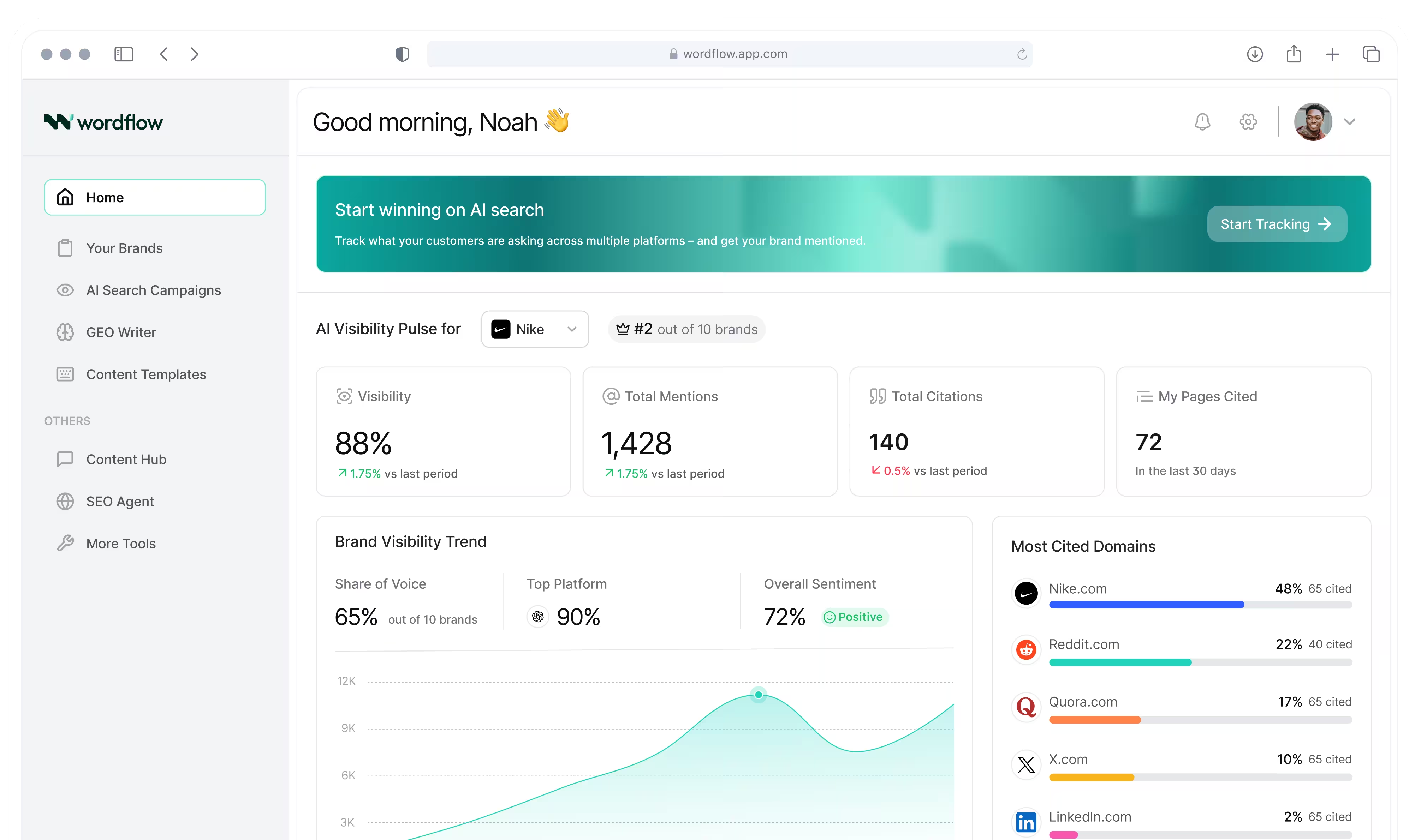
Within Wordflow, teams can build an AI Search Campaign around the questions that matter to your target audience. The platform suggests relevant topics and realistic buyer prompts, which users can accept, edit or expand with their own questions.
Wordflow then sends each tracked prompt to the selected AI platforms and captures the responses for analysis.
This process uses live prompt simulations rather than relying on a prebuilt dataset. It records the answer generated at that time, providing a closer view of what a buyer could encounter when asking the same question.
For each prompt, Wordflow measures:
- Brand visibility
- Total mentions
- Cited pages
- Share of voice against selected competitors
- Sentiment and brand positioning
These signals are tracked across seven AI platforms: ChatGPT, Claude, Perplexity, Gemini, Google AI Overviews, Grok and DeepSeek.
Prompts are also categorised by intent, helping teams assess visibility from early research through to transactional questions. Prompts where competitors appear but your brand does not are identified as missed prompts and added to the GEO Action Hub as prioritised opportunities.
Teams can then use GEO Writer to create content based on those findings, with Brand Profiles and Compliance Checklists applied during the content creation process.
All paid plans track prompts weekly across the seven supported platforms. Pro and Agency customers can add daily tracking for selected prompts to capture more of the variation in AI-generated answers. The Free plan includes weekly ChatGPT tracking.
If you are unsure which prompts your brand already appears in, Wordflow’s Free Scan provides a starting point. It checks your brand across ChatGPT, Perplexity and Google AI Overviews against three competitors, with no account required, and sends a personalised AI visibility report to your inbox.
Turn AEO prompts into measurable visibility
AI search may feel less predictable than traditional search, but AEO prompts give teams something concrete to measure. They show which questions matter to your target audience, where your brand appears and which competitors are being recommended instead.
Start with a focused set of prompts across the buyer journey and track them consistently. The resulting gaps can guide what content to create, improve or support with stronger evidence and third-party citations.
Traditional SEO still matters, but it no longer provides the complete picture. Combining SEO with AEO and GEO helps your team understand whether its content is not only ranking, but also being mentioned, cited and trusted inside the answers shaping buyer decisions.
Frequently asked questions
What does AEO stand for?
AEO stands for Answer Engine Optimisation, the practice of optimising a brand's presence inside the answers that AI assistants and answer engines produce, rather than its ranking on a search results page.
What is an AEO prompt in simple terms?
An AEO prompt is a full question a person asks an AI assistant, such as "What's the best CRM for a small sales team?", tracked as a unit of demand you can measure and optimise for. It replaces the keyword as the thing you monitor in AI search.
What is the difference between AEO and SEO?
SEO optimises how your pages rank on a search results page, where the user picks from a list of links. AEO optimises whether your brand appears inside an AI-generated answer, where the AI names only a few sources. They share foundations and work best in parallel.
Is AEO the same as GEO?
Broadly, yes. GEO (Generative Engine Optimisation) is the wider term for optimising presence in AI answers, and it largely encompasses what people mean by AEO. Both start from the prompts your target audience ask AI. The industry uses the terms interchangeably, along with AI search optimisation and, occasionally, AIO.
How do I track AEO prompts?
Build a list of the prompts your target audience ask across all four intent types, then track how AI answers them over time. Tools such as Wordflow send your tracked prompts to the major AI engines on a regular cadence and report whether you're mentioned, cited, and described accurately, and which competitors appear instead.
Read More
How Generative AI Is Rewriting the Rules of Search
Explore the shift from SEO to GEO and how to stay visible in a world of AI-generated search responses.
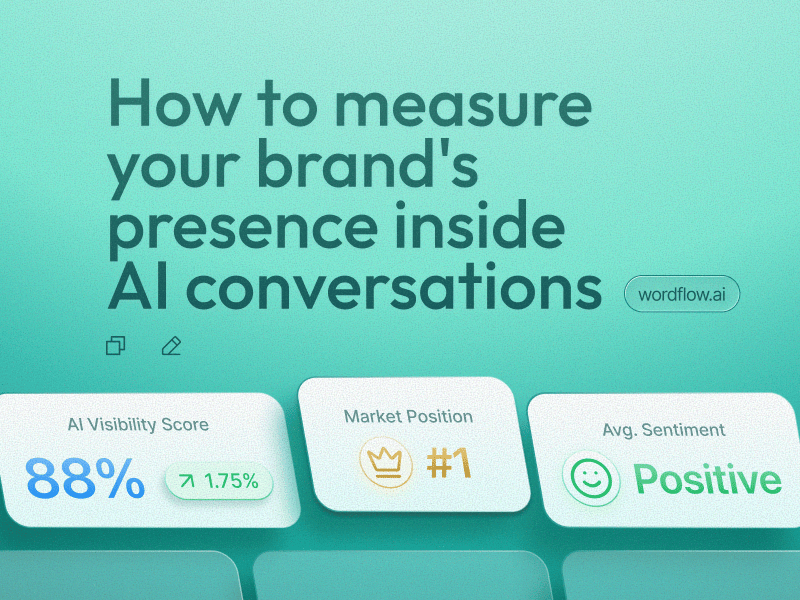
How to measure your brand's presence inside AI conversations
AI visibility doesn't have to be a guessing game. Here's what the data tells us so far.
How to Spot Content Gaps in AI Answers
AI search visibility changes content gaps from missing keywords and pages to missing inclusion, positioning, proof, and decision-ready answers that AI can confidently summarize.
Artifical Intelligence.
Real Results
Ready to transform how you market? Start your unlimited free trial today and experience the advantage Wordflow brings to your results.