December 24, 2025
How Generative AI Is Rewriting the Rules of Search
Explore the shift from SEO to GEO and how to stay visible in a world of AI-generated search responses.
Imagine someone asks ChatGPT for a recommendation. Your brand’s blog post helps inform the answer. But your brand name is never mentioned.
This is what visibility looks like in the age of generative engines.
Search once rewarded backlinks and keyword precision. Generative platforms now surface direct, citation-free responses built from multiple sources. A large portion of this content originates from brands, yet often appears without attribution.
According to McKinsey, AI-driven search interfaces are projected to drive 750 billion dollars in consumer spend by 2028. At the same time, data from Semrush shows that AI Overviews are triggered for a significant percentage of search queries, with nearly 25 percent of queries producing an AI summary at peak periods in 2025. Meanwhile, various signals suggest that a growing percentage of global Gen Z and millennial consumers begin their research on an AI interface rather than through traditional search engines.
This evolution presents a new challenge for marketers, agencies, and SEO teams. Traditional visibility metrics still matter, but discovery increasingly hinges on whether an AI system selects and references your content. Being ranked is no longer enough. Brands must be represented in the responses themselves.
From Keywords to Citability: Understanding GEO
Search Engine Optimisation (SEO) remains essential. However, the emergence of generative platforms adds new dimensions to how brands are discovered.
This is where Generative Engine Optimisation (GEO) becomes relevant. GEO focuses on how content is interpreted, summarised, and cited by large language models. Its goal is not to drive click-throughs but to ensure brand inclusion in AI-generated outputs.
Recent research from Gartner and Stanford University highlights that large language models favour content that is:
- Structurally clear (including FAQs, glossaries, headings)
- Source-supported (with links, citations, and timestamps)
- Contextually authoritative (written with depth and purpose)
A study by researchers at the University of Toronto found that pages featuring structured formatting and verifiable sources were 37 percent more likely to be cited by ChatGPT, Gemini, or Perplexity.
GEO does not replace SEO. It extends it. For content teams seeking long-term visibility, the priority is no longer just ranking highly. It is being included, interpreted, and trusted within generative outputs that shape decisions upstream of the click.
How Search Has Evolved
The early years of SEO were shaped by formulaic optimisation. Success depended on keyword repetition, link volume, and title tags. These mechanics often overpowered content quality.
This changed throughout the 2010s. Algorithmic updates such as Panda, Penguin, RankBrain, and BERT prioritised user intent, semantic relevance, and content experience. Mobile-first indexing and Core Web Vitals made speed, structure, and design critical factors.
The next shift came with voice and visual search. Consumers began asking questions aloud or using cameras to trigger discovery. Marketers responded with more conversational phrasing and embedded metadata to serve this broader surface area.
Today, another shift is underway. Generative search platforms no longer direct users to a series of links. Instead, they return synthesised responses, shaped by context and assembled from a wide variety of content. These platforms are designed for convenience. In many cases, the journey ends within the interface.
This alters the rules of discoverability. Brands now compete not only for position on a results page but also for presence in the narratives that AI tools construct. Visibility in this context means being remembered, not merely found.
What GEO Looks Like in Practice
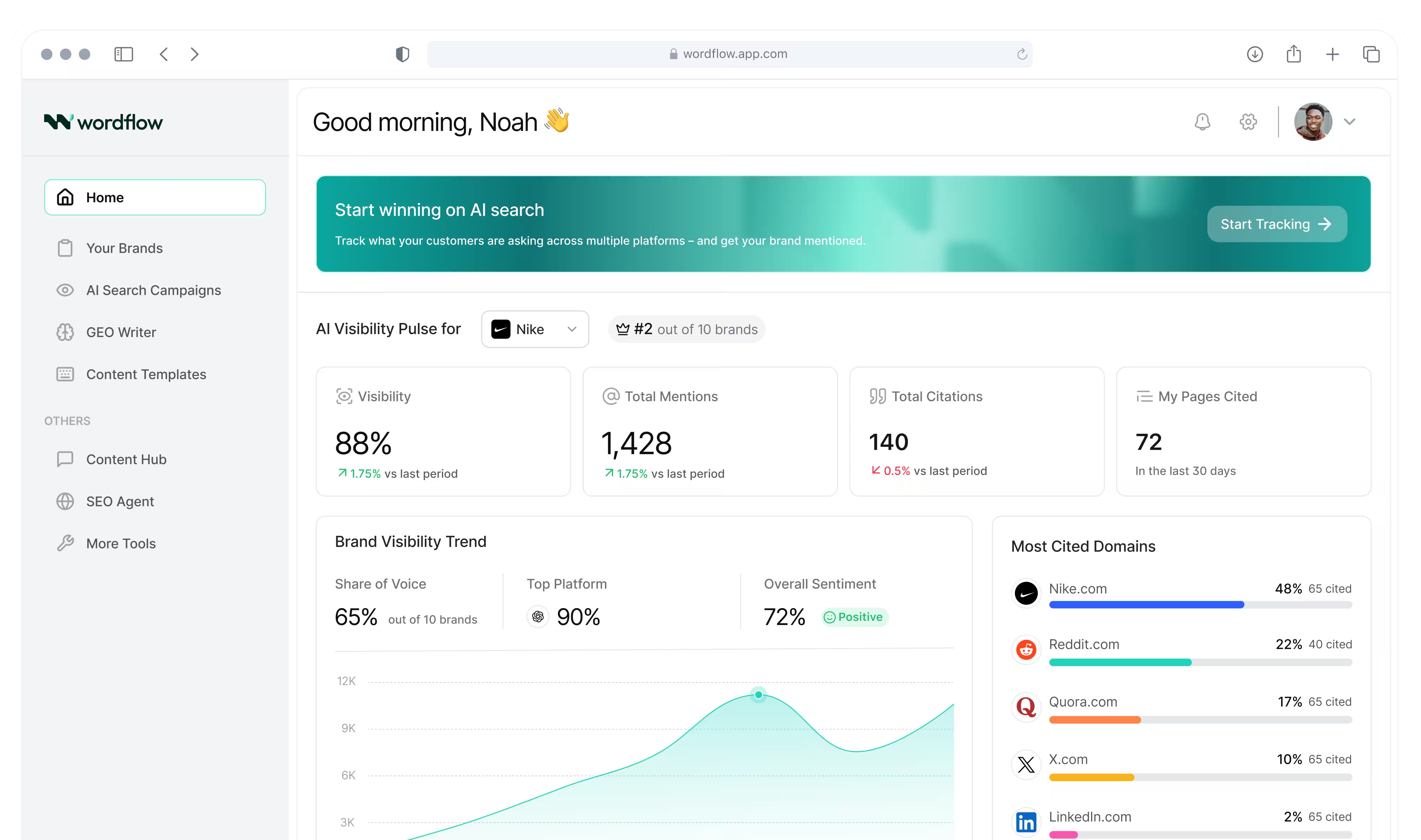
At Wordflow, we’ve found that content teams are beginning to monitor AI visibility with the same intensity previously reserved for SERP performance. This includes tracking which pages are cited, how frequently, and in what context.
Structuring for Citability
Pages that appear in generative outputs often share predictable traits. These include:
- Clearly defined sections and subheaders
- Concise summaries and definitional content
- Citation-ready elements like dates, sources, and statistics
- Author attribution and publishing timestamps
- Structured formats such as FAQs, glossaries, and numbered lists
These features support machine interpretation and allow large language models to extract usable snippets more confidently.
Strengthening Technical Signals
Technical optimisation remains essential. Schema markup, canonical tags, and internal link structures help define topical boundaries and clarify intent. These factors improve how content is understood and associated with specific queries.
Some teams are also experimenting with content formats designed specifically for AI ingestion. These include summary boxes, zero-click response modules, and structured explanations that mirror how LLMs present information.
Prioritising Evergreen Authority
Pages that answer high-intent, evergreen questions continue to perform best in generative interfaces. This includes foundational explainers, product comparisons, and decision-support guides.
Examples include:
- “What is [X]?”
- “[X] vs [Y]: Which Should You Choose?”
- “Best Practices for [X] in 2025”
These content types are resilient. They align with AI models' preference for consistency, context, and clarity. When paired with internal linking, clear sourcing, and up-to-date references, they serve as reliable building blocks for citation.
New Benchmarks for Visibility
Generative Engine Optimisation introduces a different measurement framework. It focuses less on traffic and engagement, and more on the influence of content across decision-making interfaces.
Relevant metrics now include:
- Brand citation frequency across ChatGPT, Perplexity, Gemini, Claude, and others
- Sentiment analysis of mentions in AI outputs
- Share of voice within relevant prompts and queries
- Visibility overlap or gaps compared to direct competitors
- Presence across formats such as AI overviews, chat responses, and summaries
These indicators, which Wordflow already provides, are beginning to supplement traditional dashboards. As generative engines mature, they provide a more accurate view of where content is actively shaping user decisions.
The Visibility Stack Has Split
Visibility no longer lives in one layer. It now requires coordination across two distinct but interrelated stacks.
The algorithmic stack continues to prioritise metadata, indexability, and search rankings. The generative stack focuses on content structure, topical authority, and summarisation readiness.
Brands that treat these two visibility layers as separate but mutually reinforcing will outperform those that continue optimising for search alone.
GEO helps identify gaps that traditional SEO cannot see. It provides insight into how content is interpreted across engines, how often it is referenced, and where strategic improvements can elevate the likelihood of inclusion.
The discoverability landscape is fragmenting. Platforms like Google, ChatGPT, Gemini, and Perplexity are shaping parallel environments for brand visibility.
In this environment, visibility means more than being seen. It involves being selected, cited, and trusted within compressed experiences that increasingly replace browsing behaviour.
GEO offers marketers a path forward. It reframes optimisation as a question of relevance and recognition in systems that blend context, summarise knowledge, and collapse decision journeys into a single output.
This shift is already happening. For marketers who want to remain visible in an AI-mediated world, the time to adapt is now.
Read More
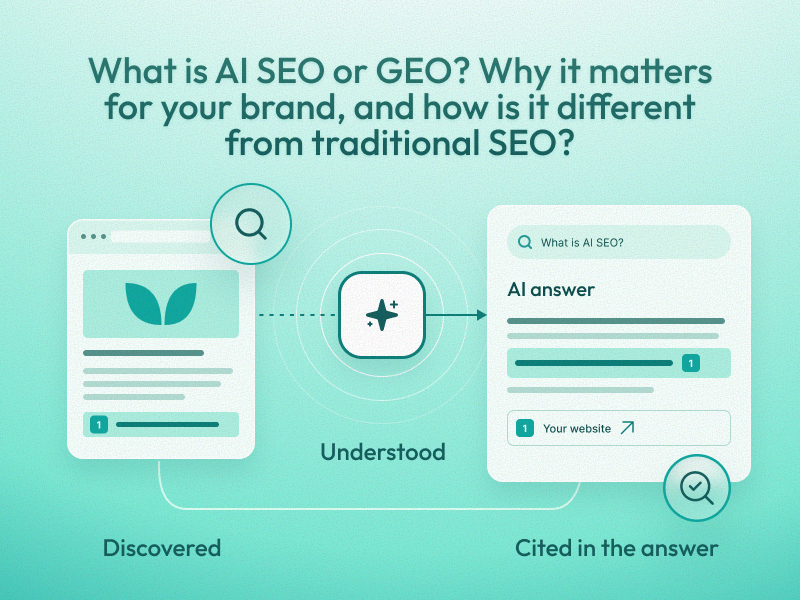
What is AI SEO or GEO? Why it matters for your brand, and how is it different from traditional SEO?
Talks about what AI SEO is, what the different terminologies mean, and how companies could utilise it.
AI Search Optimisation: How to Get AI to Recommend Your Brand, Not Just Mention It
AI can mention your brand and still recommend a competitor. Learn how AI search optimisation, or AI SEO, gets your brand recommended, not just mentioned.
Does AI Know Your Business Exists? How to Navigate AI SEO and What to Fix First
Missing from AI answers? Learn the four reasons AI leaves a brand out, how to find which one applies to you, and where to start with AI SEO.
Artifical Intelligence.
Real Results
Ready to transform how you market? Start your unlimited free trial today and experience the advantage Wordflow brings to your results.