June 29, 2026
AI Search Visibility Tools: What to Look for in 2026
Compare AI search visibility tools in 2026 and learn what to look for, from multi-engine tracking to citations, sentiment, and content workflows.
If you have typed your brand name into ChatGPT and watched a competitor appear instead of you, you already understand why AI search visibility tracking matters.
Search visibility is no longer only about where your website ranks on Google. It is also about whether your brand is mentioned, cited, recommended, or ignored inside AI-generated answers.
That is why the AI search visibility tool category is becoming important for SEO teams, content teams, agencies, and SaaS marketers. These tools help you understand how your brand appears across platforms like ChatGPT, Perplexity, Google AI Overviews, Gemini, Claude, Grok, and DeepSeek.
The shift is happening faster than many marketers realise. According to Search Engine Land, 37% of consumers now start their searches with AI tools instead of Google. At the same time, ChatGPT has crossed 900 million weekly active users, up from 400 million in February 2025. Semrush data shows ChatGPT now receives more than 5 billion monthly visits, making it the fourth most-visited website in the world.
The challenge is that the category is still new. Some platforms work like a basic AI search checking tool. Others are more advanced AI visibility trackers with competitor benchmarking, prompt research, citation analysis, sentiment tracking, and content workflows.
This blog explains what an AI search visibility tool does, how it differs from a traditional SEO rank tracker, what features matter most, and how the main tools compare.
What is an AI search visibility tool?
An AI search visibility tool tracks how your brand appears in AI-generated answers.
Instead of only measuring where a page ranks for a keyword, it measures whether AI systems mention your brand when users ask relevant questions.
For example, a traditional SEO tool might tell you that your page ranks in position four for "best logistics software in Australia".
An AI search tracker looks at a different question.
When someone asks ChatGPT, Perplexity, or Google AI Overviews for the best logistics software in Australia, does your brand appear in the answer? Is it recommended? Is it cited? Is it described accurately? Which competitors appear instead?
A strong AI search visibility tool should help you understand:
- How often does your brand appear across AI engines
- Which prompts trigger your brand mentions
- Which competitors are being recommended instead
- Whether AI systems describe your brand correctly
- Which sources do AI engines use when forming answers
- What content gaps may be limiting your visibility
This makes AI search tracking useful for any team that needs to understand how buyers discover, compare, and evaluate brands through AI-generated answers.
Why AI search visibility is different from SEO ranking
Traditional rank tracking is based on a visible results page. You choose a keyword, track your ranking position, and monitor whether that position moves up or down.
AI search works differently.
AI-generated answers are not fixed lists of links. They are generated responses. The answer can change depending on the platform, the wording of the prompt, the user context, the freshness of available sources, and the model being used.
This means one manual check is not enough.
You might appear in one ChatGPT answer but not another. You might be cited by Perplexity but missed by Google AI Overviews. You might be mentioned positively in one response but described inaccurately in another.
That is why AI search tracking needs to be measured across multiple engines, prompts, competitors, time periods, and source types. The goal is not to treat one answer as the truth. The goal is to identify patterns.
For marketers, this changes the way content needs to be planned, structured, and measured. Traditional SEO signals still matter, but they are no longer the whole picture.
What a good AI search visibility tool should measure
Not every AI visibility tracker is built the same way. Some tools are useful for one-time visibility checks. Others are built for ongoing monitoring and content improvement.
Before choosing a platform, look at whether it can measure the signals that actually affect AI search visibility.
1. Multi-engine tracking across the platforms that matter
Any serious AI search visibility tool should track more than one platform.
At a minimum, most teams should monitor ChatGPT, Perplexity, Google AI Overviews, and Gemini. Depending on your market and audience, Claude, Grok, DeepSeek, Microsoft Copilot, and Google AI Mode may also matter.
This is important because each AI engine behaves differently. ChatGPT may answer from model knowledge and browsing sources. Perplexity is more citation-led. Google AI Overviews is connected to search results. Gemini is closely tied to the Google ecosystem. Claude may describe brands differently depending on the prompt and source context.
If a tool only tracks one engine, it gives you a narrow view. If your buyers use several AI platforms, your visibility measurement should reflect that.
For teams specifically focused on Google's AI search experience, an AI Mode SEO tool may also be useful. But AI Mode should not be treated as the whole category. It is one part of a broader AI search visibility picture.
2. Competitor share of voice
Visibility in isolation does not tell you enough.
A brand visibility score is useful, but it becomes more meaningful when compared against competitors. If your brand appears in 20% of tracked answers, that may sound positive. But if your closest competitor appears in 65% of the same answers, there is still a clear visibility gap.
This is where share of voice matters. In AI search, share of voice indicates how often your brand appears relative to competitors across a defined set of prompts and platforms.
A good AI search visibility tool should show which competitors appear most often, which prompts they are winning, which engines favour them, whether they are being cited or only mentioned, and which sources appear to support their visibility.
This helps teams move from "Are we showing up?" to "Are we showing up where buyers are making comparisons?"
3. Prompt-level tracking and gap intelligence
Keywords still matter, but AI search is more prompt-led.
Buyers do not only search for short keywords. They ask full questions, such as: What is the best AI search visibility tool for a SaaS company? Which LLM SEO tools can track brand mentions in ChatGPT? How do I improve my brand visibility in Google AI Overviews?
A strong AI search tracker should help you understand which prompts matter most, where your brand appears, and where competitors are being mentioned instead.
This is the difference between surface-level monitoring and useful gap intelligence. A weak tool may tell you that your brand visibility is low. A stronger tool shows you the exact prompts you are missing, which competitors are winning them, and what content or source gaps may be causing the issue.
4. Sentiment and accuracy analysis
Being mentioned is not always enough.
AI systems may mention your brand but describe it incorrectly. They may use outdated positioning, list the wrong features, confuse your product category, or frame a competitor more favourably.
This matters because AI-generated answers can influence buying decisions before a user ever visits your website. A good AI visibility tracker should help you assess whether your brand is described accurately, whether the mention is positive, neutral, or negative, and whether competitors are being positioned more strongly.
For brand, content, and product marketing teams, this is especially important. AI search visibility is not only about presence. It is also about perception.
5. Citation and source analysis
AI search rewards content that is clear, specific, and easy to cite. That is why source analysis matters. If an AI engine recommends a competitor, you need to know what sources are supporting that recommendation.
Those sources may include product pages, blog articles, comparison pages, review sites, third-party listicles, documentation, press coverage, community discussions, and partner pages.
A strong AI search visibility tool should help you identify which sources are being cited and which sources are missing. This is where AI search tracking connects directly to content strategy. If AI systems are citing competitor comparison pages, outdated third-party articles, or review profiles instead of your own content, that tells you where your visibility strategy needs work.
6. Content execution and workflow support
Measurement is only useful if it leads to action.
This is where many AI search visibility tracking tools fall short. They can show you that your brand is missing from important prompts, but they do not always help you create the content needed to close the gap.
In AI search, improving visibility often requires creating clearer answer-led content, building comparison pages, strengthening category definitions, updating product positioning, improving citation-worthy sections, and creating content around prompts buyers actually ask.
This is why the best LLM SEO tracking tool for your team may not be the one with the most dashboards. It is the one that helps you move from visibility insight to content action.
How the main tools compare
The table below compares leading AI visibility tools across the capabilities that separate comprehensive platforms from partial tracking solutions.
Most tools can monitor whether your brand appears in AI answers. Fewer tools connect that data to prompt research, citation-level analysis, traditional SEO signals, content execution, and brand governance.
Here is what each tool does well and where it fits.
Wordflow
Best for teams that want AI visibility tracking connected to content execution
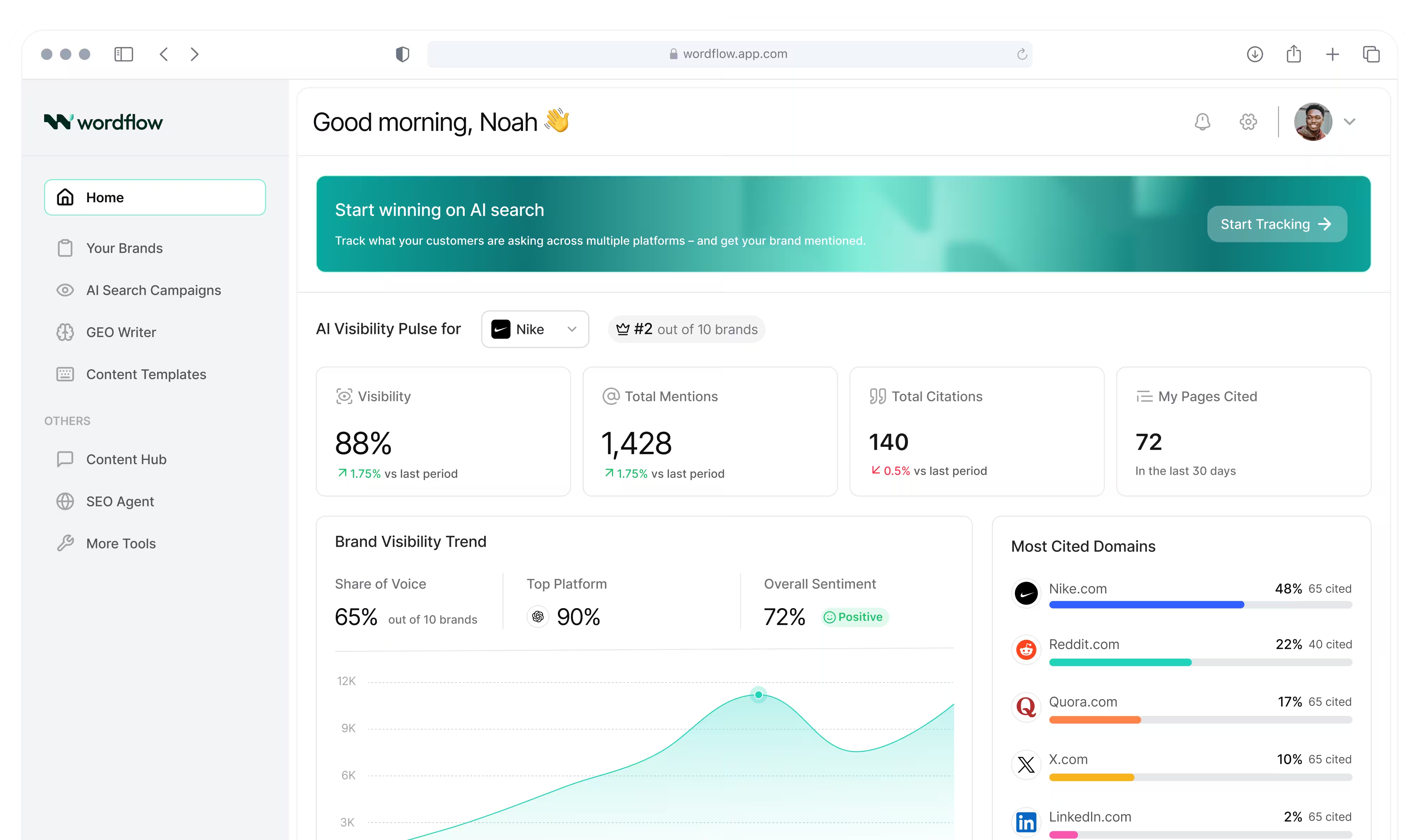
Wordflow is built for teams that want to improve AI search visibility through content, not just monitor where they stand. It tracks brand visibility across seven AI engines, including ChatGPT, Claude, Perplexity, Gemini, Google AI Overviews, Grok, and DeepSeek. It also identifies prompt and citation gaps, analyses sentiment, and connects those insights to GEO content creation through GEO Writer.
The platform also includes Templates, Brand Profiles, and Compliance Checklists, helping teams create content that is structured, accurate, and aligned with brand requirements from the start. This makes Wordflow a strong fit for SEO teams, content teams, SaaS brands, and agencies that need a complete AI visibility workflow. Instead of stopping at measurement, it helps teams move from "we are missing from these prompts" to "this is the content we need to create or improve”.
Nightwatch
Best for SEO teams that want AI visibility tracking alongside traditional rank tracking
Nightwatch is one of the strongest pure-tracking options in the category. It brings AI visibility tracking and traditional rank tracking into the same workflow, making it useful for SEO teams that want AI search visibility data without leaving their existing reporting structure.
The platform tracks brand mentions, citations, recommendations, and share of voice across major LLMs, while also supporting classic SEO rank tracking. The main gap versus Wordflow is execution. Nightwatch is strong on measurement, but it does not provide a dedicated GEO content workflow or built-in brand and compliance governance at the point of creation.
Otterly AI
Best for teams starting with simple AI search monitoring
Otterly AI is a good entry point for teams that want to start monitoring AI search visibility without a heavy setup. It tracks brand mentions, citations, and share of voice across major AI search platforms, including ChatGPT, Perplexity, Google AI Overviews, AI Mode, Gemini, and Copilot.
Its interface is simple, and the platform is useful for understanding where your brand appears, where competitors are mentioned, and which AI answers are citing your content. The limitation is that it remains mostly a monitoring platform. It can show visibility gaps and citation patterns, but it does not offer a full content execution layer, traditional SEO workflow, or brand governance system.
Knowatoa AI
Best for teams focused on AI brand perception and sentiment
Knowatoa AI is positioned around AI search monitoring, sentiment, and brand perception. It helps teams understand whether their brand appears in AI answers, how visibility changes over time, and whether AI systems are describing the brand accurately.
This makes it useful for teams that care about brand positioning accuracy, not just mention volume. However, it is less complete as an end-to-end content workflow. It is not built around structured GEO content creation, SEO execution, and compliance control in the way Wordflow is.
Profound AI
Best for enterprise teams that need large-scale AI visibility intelligence
Profound AI is built for enterprise AI visibility and answer engine optimisation. It is designed for larger teams that need reporting across AI visibility, source citations, and content strategy at scale.
It is a credible option for enterprise marketing, PR, and brand teams that need a broader intelligence layer around AI-generated answers. For many growth and content teams, the trade-off is complexity and access. Profound is built for enterprise workflows, and its pricing and sales process reflect that. Wordflow, by comparison, is more directly focused on turning visibility gaps into AI-ready content that teams can publish and manage.
Peec AI
Best for smaller teams that need straightforward AI search analytics
Peec AI is a straightforward AI search analytics platform for marketing teams. It tracks prompts, brand visibility, source citations, and competitor performance across selected AI models.
For smaller teams that want to understand how their brand appears in AI search and which sources are influencing those answers, it provides a clear monitoring layer. The limitation is that it does not replace a content execution system. Peec AI can help identify visibility gaps, but teams still need a separate process to create, optimise, and publish content designed to improve those gaps.
Which Wordflow plan is right for your team?
The right plan depends on how many prompts you want to track, how often you need updates, and how many brands or workflows your team manages.
How to get started with Wordflow
The fastest way to start is with a free AI visibility scan at wordflow.ai/free-scan.
Enter your brand name, industry, and target market, and Wordflow will return a visibility report across key AI search platforms. This gives you an initial view of whether your brand appears, how competitors compare, what AI systems are saying about you, and which gaps may need attention.
From there, a paid plan gives your team access to a fuller AI visibility workflow, including AI Search Campaigns, prompt tracking, competitor monitoring, GEO Writer, Brand Profiles, Compliance Checklists, and content workflows.
A practical first workflow looks like this:
- Define your core buyer prompts
- Track your brand and key competitors across multiple AI engines
- Review which prompts you appear in and which ones you miss
- Analyse the sources AI engines cite
- Identify content gaps and outdated positioning
- Create or refresh content around high-priority prompts
- Monitor whether visibility improves over time
This turns AI search visibility from a vague concern into a measurable content strategy.
Final thoughts
AI search visibility is becoming a core part of modern SEO.
Ranking on Google still matters, but it no longer gives the full picture. A brand can rank well and still be absent from ChatGPT, Perplexity, Google AI Overviews, or Gemini when buyers ask for recommendations.
With 37% of consumers now starting searches in AI tools and ChatGPT attracting more than 900 million weekly active users, visibility inside AI-generated answers is quickly becoming as important as visibility in traditional search results.
That is why AI search visibility tools are becoming important for marketers, SEO teams, agencies, and content teams.
The best tool is not simply the one that shows the most charts. It is the one that helps you answer three practical questions: Are we appearing in the AI answers that matter? Are we being described accurately and competitively? What do we need to create, improve, or clarify to show up more often?
For teams that want to connect AI search tracking with content action, Wordflow gives you a structured way to measure visibility, identify gaps, and create content designed for how search is changing.
Start your free scan at wordflow.ai/free-scan, or book a demo to see the full platform in your category.
Wordflow is Australia's first AI search and content engineering platform. AI Search Campaigns and GEO Writer are available on Starter, Pro, and Agency plans; Wordflow Insights is available on Pro and Agency. 14-day free trial included.
Read More
How Generative AI Is Rewriting the Rules of Search
Explore the shift from SEO to GEO and how to stay visible in a world of AI-generated search responses.
How to measure your brand's presence inside AI conversations
AI visibility doesn't have to be a guessing game. Here's what the data tells us so far.
How to Spot Content Gaps in AI Answers
AI search visibility changes content gaps from missing keywords and pages to missing inclusion, positioning, proof, and decision-ready answers that AI can confidently summarize.
Artifical Intelligence.
Real Results
Ready to transform how you market? Start your unlimited free trial today and experience the advantage Wordflow brings to your results.