January 19, 2026
How to measure your brand's presence inside AI conversations
AI visibility doesn't have to be a guessing game. Here's what the data tells us so far.
How to measure your brand's presence inside AI conversations
When funnels collapse and the buyer journey starts and stops inside AI answers, how should marketers think about visibility?
Across nearly 70,000 unique Google Searches, Pew Research found that users clicked on a traditional search result just 8% of the time whenever an AI summary appeared, compared to 15% when there wasn’t one. Half of all clicks simply vanished, and it suggests that consumers are already defaulting to AI answers to guide their decisions - a shift that, according to McKinsey, could funnel US$750 billion in revenue through AI search by 2028.
Traditionally, brand presence was basically search traffic. Rankings, clicks, and whether your spend was capturing attention. The levers were clear, and so was measurement.
That clarity is gone. Most marketers today still don’t know how to measure this new kind of visibility systematically. From discovery calls and industry conversations, many teams fall back on static, surface-level signals that are biased, hard to track, and impossible to improve over time.
Case in point: “optimised” prompt lists that claim specific outcomes. Research on prompt sensitivity shows that small wording or formatting tweaks can dramatically change answers. Even with identical prompts, outputs can still vary because of how models generate responses. Consequently, there’s no stable baseline to analyse, improve, or scale.
At Wordflow, we’re helping brands understand how they appear in AI search visibility, what their customers are asking, and how they can create content that wins AI citations. Here’s what actually works instead.
A framework that holds up for AI search visibility
Let’s not skip the basics: when measuring anything meaningfully, sample size and consistency matter. At Wordflow, we’ve been running multiple prompt variations on different topics across various models at a regular cadence. Simply put, you need a system to effectively measure brand presence.
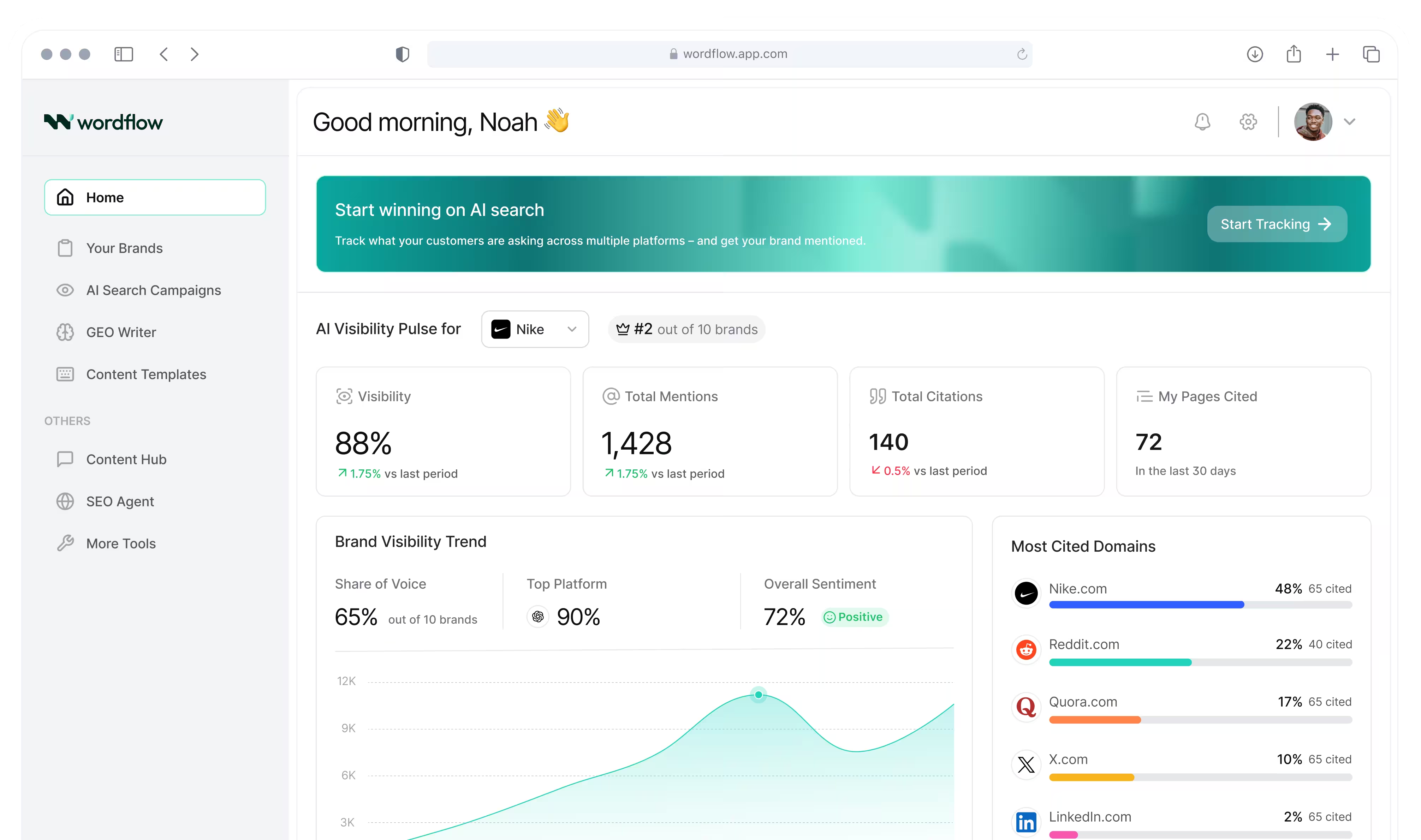
Our observations so far lead us to believe that such a system should track these four metrics:
- Visibility rate: The percentage of relevant prompts that mention your brand at all.
- Share of voice: mentions of your brand as a percentage of total category mentions.
- Sentiment distribution: whether your brand is framed positively, neutrally, or negatively.
- Position-adjusted visibility: being mentioned early in an AI answer usually counts for more than being mentioned as an afterthought.
On position-adjusted visibility, we’ve also found academic research that supports our observation. Some research measures this by giving more ‘credit’ to brands and sources that show up near the top of the response, and less credit to those that appear later. The key idea is that it’s about where your brand appears in the AI answer itself, not where a link ranks on a SERP.
Naturally, not all prompts are created equal. Rather than capturing these metrics across the board, we’ve found it important to also map brand visibility by topics that closely match buyer intent.
- High-intent topics look like “best [category] for [use case]” or comparisons.
- Educational topics are “how does [category] work” or industry trends.
- Problem-aware topics are “how to solve [pain point]” when the person has not yet decided what category they need.
Tracking by cluster helps you avoid a common trap: dominating educational prompts while disappearing from the prompts where someone is actually choosing a vendor.
Then there’s the question of which sources shape answers. AI answers synthesise from across the web, not just your owned content. In many cases, a brand’s own sites make up only 5–10% of the sources AI-powered search references, with answers pulling from a broader mix that includes affiliates and user-generated content.
So check the footnotes, inline citations, or sources list when visible. Track how often your owned domains appear, which third-party sites dominate, and whether competitors are being cited more frequently. This tells you where to focus distribution efforts. If the answer layer trusts certain publications in your space, you need presence there.
Turning AI citations and insights into action
Once a system of measurement is in place, keep the insights generated practical by treating the four metrics as signals that indicate what kind of problem your brand actually has.
When visibility is low on high-intent topics, it usually means buyers are asking the right questions and your brand is not part of the shortlist. Start by looking at the exact prompts where you are missing, then work backwards into what the answer layer likely lacks. Clear use-case pages and comparison pages tend to do better here, not because they are exciting, but because they answer buyer questions directly. FAQ pages help too, especially when they mirror the phrasing buyers use. The goal is to make it easy to reference when the prompt is “best”, “alternatives”, or “X vs Y”, not just when someone asks a broad educational question.
When sentiment is negative or mixed, that’s a different issue. Your brand is present, but it’s being framed in a way that makes buyers hesitate.Identify recurring critiques and where they are coming from. Part of the problem may lie in your brand messaging, but if criticism is coming from external sources, you should deal with these narratives where they are forming.
When competition is strong in specific topics, you should double down on targeted work. Look for the topics where competitors repeatedly appear ahead of you, then create genuinely useful resources on those exact themes. Pair that with distribution into the external domains that AI assistants already trust.
And if your owned domains rarely get cited, treat that as a credibility signal. It does not automatically mean your content is bad, but it does suggest your content is not being treated as a reference point.
Make AI search visibility a manageable routine
Finally, set a regular cadence. Run your prompt set across platforms, review shifts in visibility, share of voice, sentiment, and citations, pick one or two high-impact gaps, ship improvements, and watch what moves in the next cycle.
We recommend having each cycle ending with a decision you can actually act on. For example, If visibility is slipping on comparison prompts, ship a clearer use-case or comparison page; if sentiment is wobbly, tighten brand messaging and address any recurring critiques where they are forming. If competitors keep getting cited from the same few domains, focus your distribution efforts there.
Right now, only 16% of brands today systematically track AI search performance. That gap represents opportunity, and brands that treat AI visibility as something measurable and repeatable will win the day. Not sure where to start? Connect with us and see how Wordflow’s AI search visibility and content automation capabilities make AI notice your brand.
Read More
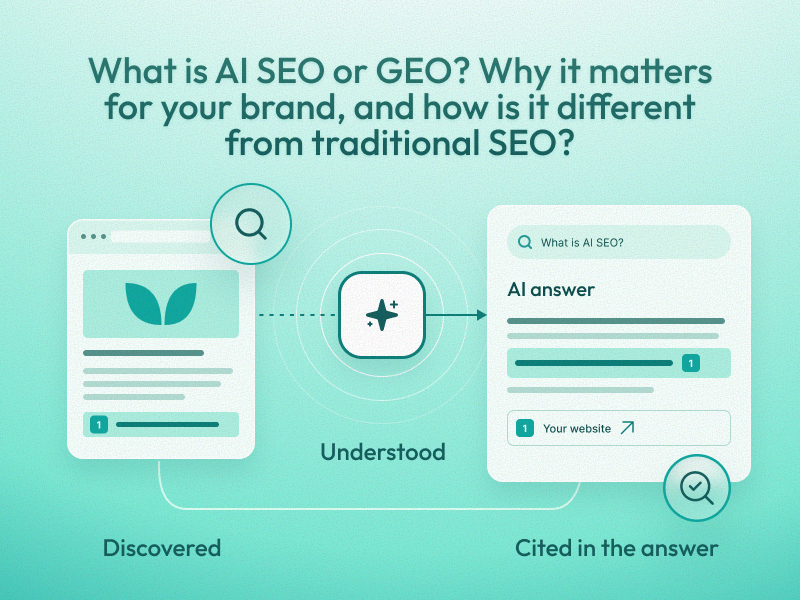
What is AI SEO or GEO? Why it matters for your brand, and how is it different from traditional SEO?
Talks about what AI SEO is, what the different terminologies mean, and how companies could utilise it.
AI Search Optimisation: How to Get AI to Recommend Your Brand, Not Just Mention It
AI can mention your brand and still recommend a competitor. Learn how AI search optimisation, or AI SEO, gets your brand recommended, not just mentioned.
Does AI Know Your Business Exists? How to Navigate AI SEO and What to Fix First
Missing from AI answers? Learn the four reasons AI leaves a brand out, how to find which one applies to you, and where to start with AI SEO.
Artifical Intelligence.
Real Results
Ready to transform how you market? Start your unlimited free trial today and experience the advantage Wordflow brings to your results.