July 8, 2026
How to Track AI Citation Sources: A Step-by-Step Guide
Learn how to track AI citation sources, spot where your brand is missing, and turn citation gaps into content actions.
AI search is changing how people discover brands.
AI Overviews now appear across a significant share of Google searches, especially for informational and question-based queries. Google also says AI Overviews reach more than 2.5 billion monthly users, while AI Mode has passed 1 billion monthly users.
The impact on organic traffic is already visible. Studies have found that AI Overviews can reduce organic clicks, while increasing zero-click behaviour.
That changes how marketers need to think about visibility.
When someone asks ChatGPT, Perplexity, Gemini, or Google AI Overviews which platforms to consider, the answer is shaped by the sources the system decides to trust. These may include your website, third-party reviews, directories, comparison articles, community discussions, and competitor content.
Traditional SEO still matters. But the question is no longer only whether your content ranks. It is whether AI systems can understand, extract, trust, and cite it when answering buyer questions.
That is where AI citation tracking comes in. It helps you see which sources are shaping AI-generated answers, whether your brand is included, and what content or off-page gaps need to be fixed.
What is AI citation tracking?
AI citation tracking is the process of monitoring the sources AI platforms reference when they answer questions related to your brand, product, competitors, or category.
A citation is a specific source an AI answer draws on or links to. This could be your website, a competitor's blog, a review site, a media article, a comparison page, a community discussion, or an industry directory.
It is different from a brand mention.
A brand mention tells you whether your brand appears in the answer. A citation tells you which source helped shape that answer.
Both are important.
AI mention tracking shows whether your brand is visible inside AI-generated answers. AI citation tracking shows which sources the AI system appears to trust, and whether your own content is part of that source set.
For marketers, this distinction matters. You may be mentioned in an answer but not cited. You may be excluded from an answer because the cited sources do not include your brand. Or you may be described inaccurately because the AI system is drawing from outdated third-party content.
A complete AI search visibility strategy should track both mentions and citations.
Why AI citations matter for brand visibility
In traditional search, users are given a list of links. Your goal is to rank high enough that someone sees your result, clicks through, and evaluates your content.
AI search works differently.
In many AI-generated answers, the user receives a direct summary, recommendation, or shortlist before they ever click a link. Sometimes they do not click at all. This means visibility is no longer just about ranking. It is also about being included in the answer itself.
If your brand is not cited, mentioned, or accurately represented, you may be missing from the exact moment when a buyer is forming their shortlist.
This does not mean backlinks no longer matter. Many traditional SEO signals still influence whether your content is discoverable, trusted, and retrievable. But backlinks alone do not tell you what AI systems are actually using when they generate answers.
How AI engines choose which sources to cite
Every AI platform works differently. ChatGPT, Claude, Perplexity, Gemini, Google AI Overviews, Grok, and DeepSeek do not always use the same sources, and their answers can change over time.
However, there are a few common patterns.
AI systems tend to favour sources that are clear, specific, current, and easy to extract from. They also look for consistency across the wider web. If your website says one thing, review sites say another, and comparison articles leave you out entirely, the AI system may form an incomplete or inaccurate view of your brand.
In most categories, AI answers are shaped by three broad source types.
Owned content
This includes your website, blog, product pages, documentation, landing pages, case studies, and help centre content.
Owned content matters because it gives AI systems direct information from your brand. But it needs to be structured in a way that is easy to understand and cite.
A page that clearly answers a specific question is more useful than a page that only targets a keyword. For example, a direct comparison page, a pricing explanation, or a clear "how it works" guide may be easier for AI systems to extract from than a broad landing page with vague claims.
Third-party sources
This includes review sites, directories, media coverage, industry reports, comparison articles, marketplace listings, and community discussions.
AI engines often lean on third-party sources because they appear more independent. If several trusted external sources describe your brand consistently, that can strengthen your entity authority.
The problem is that many brands do not actively manage these sources. They may have outdated directory descriptions, missing review profiles, old media mentions, or third-party comparison pages that mention competitors but leave them out.
Citation tracking helps you find these gaps.
Competitor content
Competitor content can also shape AI answers, especially when your own content does not answer the question clearly.
If a buyer asks "best AI search visibility tools for agencies" and your competitor has published a better structured comparison page, their content may influence the answer. If you have no equivalent content, you are relying on third-party sources to explain your value for you.
That is risky.
Every important question your content does not answer gives another source the chance to define the category, the criteria, and the shortlist.
Step 1. Identify the prompts your brand should appear in
Start with the questions your audience is likely to ask.
This is one of the most important parts of AI citation tracking. You are not only tracking keywords. You are tracking prompt-based discovery.
A buyer may not ask "AI citation tracking software." They may ask:
- What are the best AI search visibility tools for SaaS brands?
- How do I track if ChatGPT mentions my company?
- Why is my competitor appearing in Perplexity answers?
- How do I improve brand visibility in AI search?
- What tools track citations in ChatGPT and Google AI Overviews?
These prompts represent different stages of intent. Some are informational. Some are commercial. Some are competitor-led. Some are problem-solving.
A useful starting point is to build a prompt list across four intent types:
- Informational prompts, such as What is AI citation tracking?
- Commercial prompts, such as Best AI search visibility tools for B2B marketing teams
- Problem-solving prompts, such as How do I improve brand mentions in ChatGPT?
- Transactional prompts, such as Wordflow pricing or Wordflow alternatives
For most brands, 20 to 50 prompts is enough for a first audit. The goal is not to track every possible variation. The goal is to capture the questions that matter most when buyers are researching, comparing, and shortlisting solutions.
Step 2. Run an AI citation audit across platforms
So how can you track brand mentions in ChatGPT and the other engines? Once you have your prompt list, run each prompt across the AI platforms your audience is likely to use.
This may include ChatGPT, Claude, Perplexity, Gemini, Google AI Overviews, Grok, and DeepSeek. The exact mix depends on your market, audience, and category.
For each prompt, record four things:
- Whether your brand was mentioned
- Whether your website was cited
- Which sources were cited
- How your brand was described
This gives you a simple but useful view of your AI search visibility.
For example, you may find that your brand appears in ChatGPT but not in Perplexity. Or your product page may be cited for one prompt, while a third-party comparison article is cited for another. You may also find that competitors are being recommended in prompts where your brand should be considered.
A spreadsheet is enough for a first manual audit.
However, there are two things to keep in mind.
First, AI answers can vary between runs. A single answer is not always enough to make a decision. Run important prompts more than once where possible.
Second, record the date. AI answers change as models, indexes, citations, and available sources update. An audit is not a permanent verdict. It is a snapshot of visibility at a specific point in time.
Repeating this by hand across seven engines is the part that does not scale, which is where an AI mention tracker earns its place. More on that below.
Step 3. Find missed prompts, missed sources, and misrepresentation
The value of an AI citation audit is not the spreadsheet itself. The value comes from reading the results and identifying what needs to change.
There are three important patterns to look for.
Missed prompts
These are prompts where competitors appear and your brand does not.
Missed prompts are often the highest-priority content gaps, especially when they appear in commercial or problem-solving searches.
For example, if your competitors are being recommended for "best AI search visibility platforms for agencies" and your brand is missing, that is not just a visibility issue. It is a positioning issue.
It may mean your content does not clearly explain your relevance for that audience. It may also mean third-party sources in the category do not include you yet.
Missed sources
These are sources that AI engines repeatedly cite, but where your brand is absent.
This could be a review site, listicle, analyst page, community thread, marketplace directory, or comparison article.
Missed sources are important because they show you which external pages are influencing AI answers. If the same third-party article appears across multiple prompts and platforms, it may be shaping how your category is understood.
Your goal is not to control every source. That is not realistic. But you can identify the sources that matter most and work to improve your presence in them.
Misrepresentation
This happens when your brand appears in an AI answer, but the description is outdated, incomplete, or inaccurate.
This can be harder to spot than absence, but it is just as important.
For example, an AI answer may describe your product using an old positioning statement. It may omit an important feature. It may compare you against competitors using outdated information. Or it may cite a page that no longer reflects what your platform does.
Misrepresentation usually means there is inconsistency somewhere in the source landscape.
Fixing it may require updating your own content, improving third-party listings, refreshing comparison pages, or correcting outdated public information.
Step 4. Turn citation gaps into content actions
Once you know where the gaps are, the next step is to act on them.
Most AI citation gaps point to one of two actions: on-site content improvement or off-site visibility improvement.
Improve your on-site content
If your website is not being cited for important prompts, look at whether your content answers those questions clearly enough.
AI search rewards content that is specific, structured, and easy to cite. That means your content should make key information easy to extract.
For example, instead of writing a broad blog post about "the future of AI search”, create content that answers a clear question:
- What is AI citation tracking?
- How does AI search visibility differ from SEO visibility?
- How can SaaS brands improve brand mentions in ChatGPT?
- What should agencies track across AI search engines?
Each page should have a clear purpose. Lead with the answer. Use practical headings. Explain terms naturally. Include examples. Make sure important claims are specific and verifiable.
This is where Generative Engine Optimisation, or GEO, overlaps with good SEO. The aim is not to write for machines at the expense of readers. The aim is to create content that is useful for readers and easy for AI systems to understand.
Improve your off-site visibility
If AI engines keep citing third-party sources where your brand is missing, your next action is off-site.
This may include:
- Updating directory listings
- Pitching inclusion in relevant comparison articles
- Building review presence
- Contributing to industry discussions
- Refreshing partner or marketplace profiles
- Correcting outdated brand descriptions on external pages
For many brands, this is where AI search visibility becomes a broader brand and content operation. Your website matters, but it is not the only source AI systems use to understand you.
The more consistent your brand is across trusted sources, the easier it becomes for AI systems to describe you accurately.
Step 5. Re-audit and track changes over time
AI citation tracking should not be treated as a one-off project.
A first audit tells you where you stand today. But AI answers shift as platforms update, competitors publish, third-party sources change, and your own content improves.
That is why citation tracking works best as a continuous programme.
For many teams, a weekly cadence is a sensible starting point. It is frequent enough to catch changes without overreacting to daily variation. Daily tracking can be useful for high-priority prompts, especially when you are actively publishing or trying to measure the impact of a specific campaign.
Over time, you should be looking at trends such as:
- Are we being mentioned more often?
- Are our own pages being cited more frequently?
- Which competitors are gaining or losing visibility?
- Which third-party sources appear most often?
- Are AI answers describing our brand more accurately?
This turns AI citation tracking from a reporting exercise into a practical content strategy input.
How Wordflow helps with AI citation tracking
Manual audits are useful for understanding the process. But they become difficult to maintain once you are tracking multiple prompts, competitors, and AI platforms.
This is where Wordflow helps teams move from manual checking to continuous AI search monitoring.
Wordflow tracks how your brand appears across the seven major AI answer engines: ChatGPT, Claude, Perplexity, Gemini, Google AI Overviews, Grok, and DeepSeek. Instead of relying on a static dataset, it uses live prompt simulations to capture the answers each platform gives for your tracked prompts.
ChatGPT brand monitoring on its own is a reasonable starting point, and Wordflow's Free plan covers exactly that. Paid plans track all seven engines on a weekly cadence, with a daily tracking add-on available on Pro and Agency plans for the prompts that matter most.
The workflow reflects the same audit process:
- Campaign setup helps you organise prompts by intent.
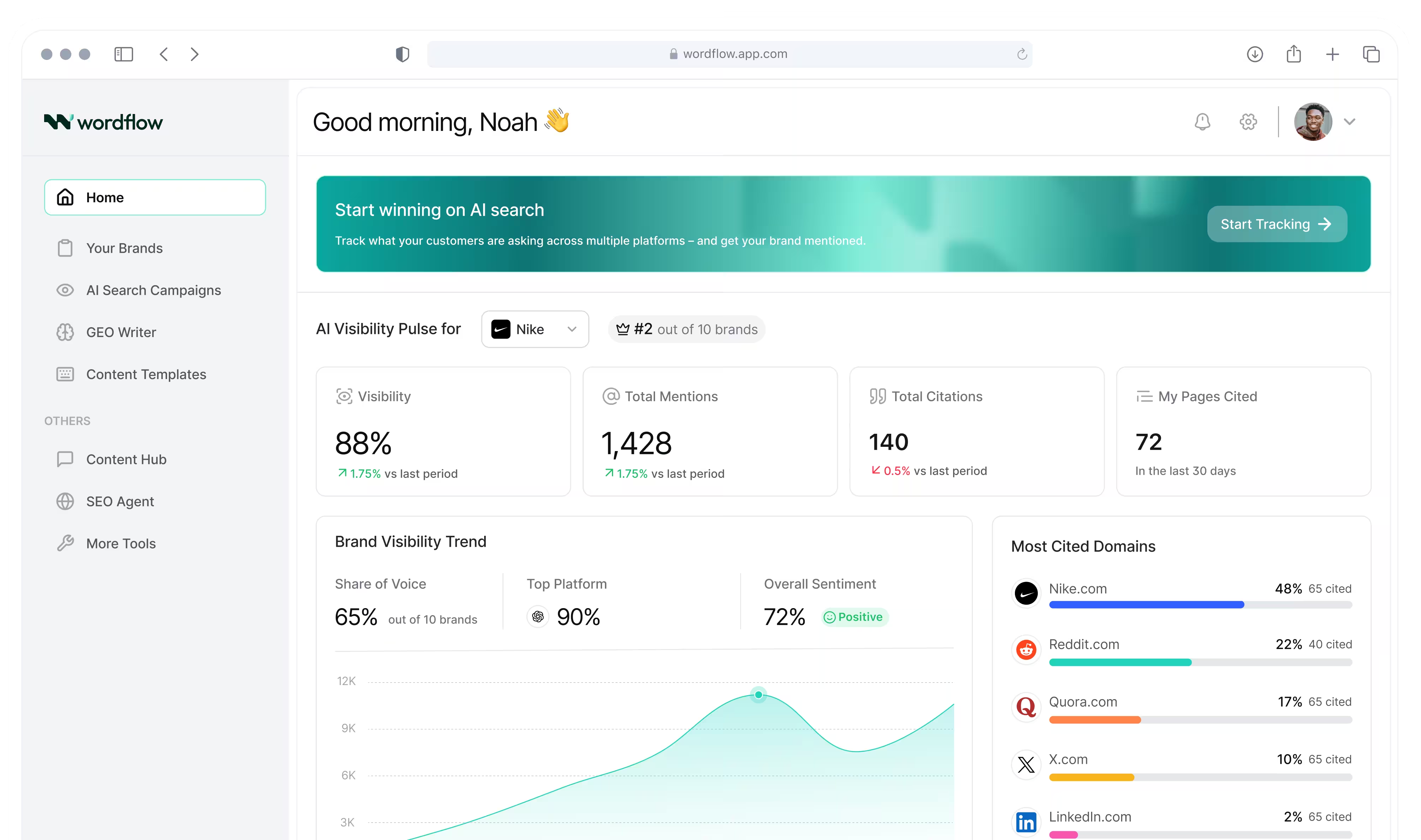
- My Pages Cited shows when your own pages are used as sources.
- Pages & Citations shows which sources are shaping answers across your tracked prompts.
- Missed Prompts highlights questions where competitors appear and your brand does not.
- Share of Voice tracks your visibility against competitors over time.
- GEO Action Hub helps turn visibility gaps into content and off-site actions, with on-page gaps executable in GEO Writer with your Brand Profile and Compliance Checklist applied.
This matters because tracking alone does not improve visibility. The real value is knowing what to fix, which prompts to prioritise, and which content or sources are most likely to influence the answer.
For teams already investing in SEO, this creates a clearer bridge between traditional search performance and AI search visibility.
Where do you stand today? Wordflow's Free Scan checks your brand's visibility across ChatGPT, Perplexity, and Google AI Overviews and sends a report to your inbox in about two minutes. No account required. Start your free scan at wordflow.ai/free-scan, or book a demo to see the full platform in your category.
Wordflow is Australia's first AI search and content engineering platform. AI Search Campaigns and GEO Writer are available on Starter, Pro, and Agency plans; Wordflow Insights is available on Pro and Agency. 14-day free trial included.
Frequently asked questions
Can you monitor real-time brand mentions in ChatGPT?
Not in the same way you can monitor a social feed or analytics dashboard.
ChatGPT does not provide a public feed of every answer it gives. The practical way to monitor visibility is to run scheduled prompt simulations and record how the answers change over time.
For most brands, weekly or daily tracking is more useful than trying to monitor every possible answer in real time. AI visibility is better measured as a trend, not a minute-by-minute metric.
What is the difference between AI citation tracking and AI mention tracking?
AI mention tracking shows whether your brand appears in AI-generated answers.
AI citation tracking shows which sources are referenced or used to support those answers.
A brand mention tells you whether you are visible. A citation tells you what is shaping that visibility.
For example, your brand may be mentioned because a third-party comparison article includes you. Or your own product page may be cited directly. These are different visibility signals, which is why most teams track AI brand mentions and citations together rather than choosing one.
What are the best tools to track mentions in ChatGPT?
The best tool depends on what you need to measure.
Some tools focus mainly on tracking AI mentions and citations. These are useful if your main goal is visibility reporting.
Other platforms connect tracking with execution. This is useful if you need to find content gaps, identify missed prompts, prioritise sources, and create content that can improve your presence in AI answers.
For SEO and content teams, the second workflow is often more practical because it connects measurement to action.
How often should you run an AI citation audit?
Weekly is a good default for most brands.
It gives you enough data to spot movement while reducing the risk of overreacting to normal answer variation. Daily tracking is useful for priority prompts, competitor comparisons, or campaigns where you are actively publishing content and want to monitor changes more closely.
A quarterly audit may be enough for a one-off benchmark, but it is usually too slow if AI search is becoming an important discovery channel for your brand.
How do you improve your chances of being cited in AI answers?
Start by improving the content and sources AI systems can learn from.
Your owned content should answer important category questions clearly. It should be structured, specific, current, and easy to extract from.
Your off-site presence should also be consistent. Review sites, directories, comparison articles, partner pages, and media mentions should describe your brand accurately.
The goal is to make your brand easier to understand, easier to verify, and easier to cite.
Read More
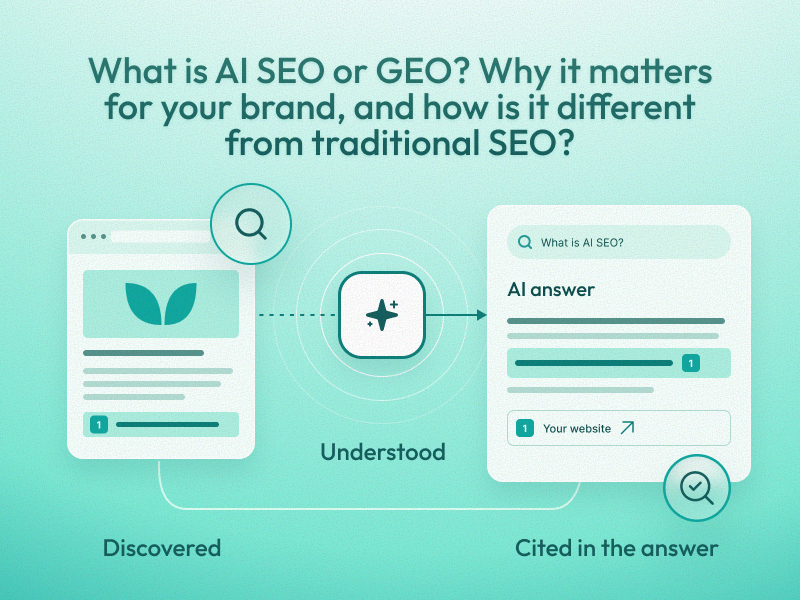
What is AI SEO or GEO? Why it matters for your brand, and how is it different from traditional SEO?
Talks about what AI SEO is, what the different terminologies mean, and how companies could utilise it.
How Generative AI Is Rewriting the Rules of Search
Explore the shift from SEO to GEO and how to stay visible in a world of AI-generated search responses.
How to measure your brand's presence inside AI conversations
AI visibility doesn't have to be a guessing game. Here's what the data tells us so far.
Artifical Intelligence.
Real Results
Ready to transform how you market? Start your unlimited free trial today and experience the advantage Wordflow brings to your results.