February 4, 2026
How to get cited in AI answers: a practical guide to Query Fan-Out
What Query Fan-Out is and why it's key to getting cited.
Lately, the clearest takeaway from our conversations with marketers is this: understanding how AI answers decide which sources to cite is fast becoming a critical skill.
To understand how brands get cited in AI answers, marketers need to grasp the mechanics that inform AI answers: how answer engines like ChatGPT, Claude, and Gemini generate responses to user prompts, and how the search process that answer engines use actually works.
The former is well-explained by SEO-PR’s Greg Jarboe: answer engines synthesize answers based on information that is in its training data, or uses retrieval-augmented generation (RAG) to search the web and relevant documents to provide a more grounded response.
The latter is where much ambiguity - and confusion - sets in. In particular, there’s a lot of chatter around answer engines having their own ranking criteria or search indices. That claim is false: answer engines do not behave the same as search engines like Google at all. Instead, their approach is often a mix of single-pass retrieval to multi-stage agentic search flows.
Within the agentic search flow is a technique called Query Fan-Out (QFO). Understanding how QFO works is instrumental to getting cited in AI answers. In this guide, we’ll talk about what QFO refers to, how to leverage QFO to win in AI search, and some best practices around the technique.
What is Query Fan-Out?
In simple terms, QFO breaks down a user prompt into several smaller and more specific questions, and runs them at the same time behind the scenes.
As a user, you can see this happening in Google’s AI Mode or ChatGPT’s Thinking Mode when the model appears to be looking up different sources during the search process. Answer engines use query fan-out (QFO) to give a fuller answer by splitting your question into a few different angles that address different intents, and also pulling in related details that help answer it better.
This means that AI answers don’t just answer the user prompt. They try to extrapolate what the user’s next steps would be and try to answer for them as well. An example:, if someone typed “best laptop for college” into Google’s AI Mode, their prompt could split that into smaller searches like “best laptops for students on a budget,” “best lightweight laptops for carrying around campus,” “best laptops for note-taking and essays,” and “best laptops with long battery life.”
Why is Query Fan-Out important to marketers?
The value that QFO has to marketers is twofold: being able to identify highly specific responses that are relevant to your brand, and also which pages are being retrieved and cited.
Because QFO breaks down user prompts into smaller, more specific questions, the subqueries can effectively be mapped to brand-adjacent needs. In other words, you can take a broad theme your brand cares about, uncover specific angles that answer engines are likely to explore, and create content that serves these angles.
Answer engines also show relevant links in the final answer - we call these links citations, and these citations can help marketers answer which exact pages are trusted and cited by answer engines, and whether competitor pages are filling in any gaps that can be captured by your brand.
How to see the Fan-Out Queries
There are currently several ways that marketers can use to visualize QFO.
- Use AI tools that make the QFO visible
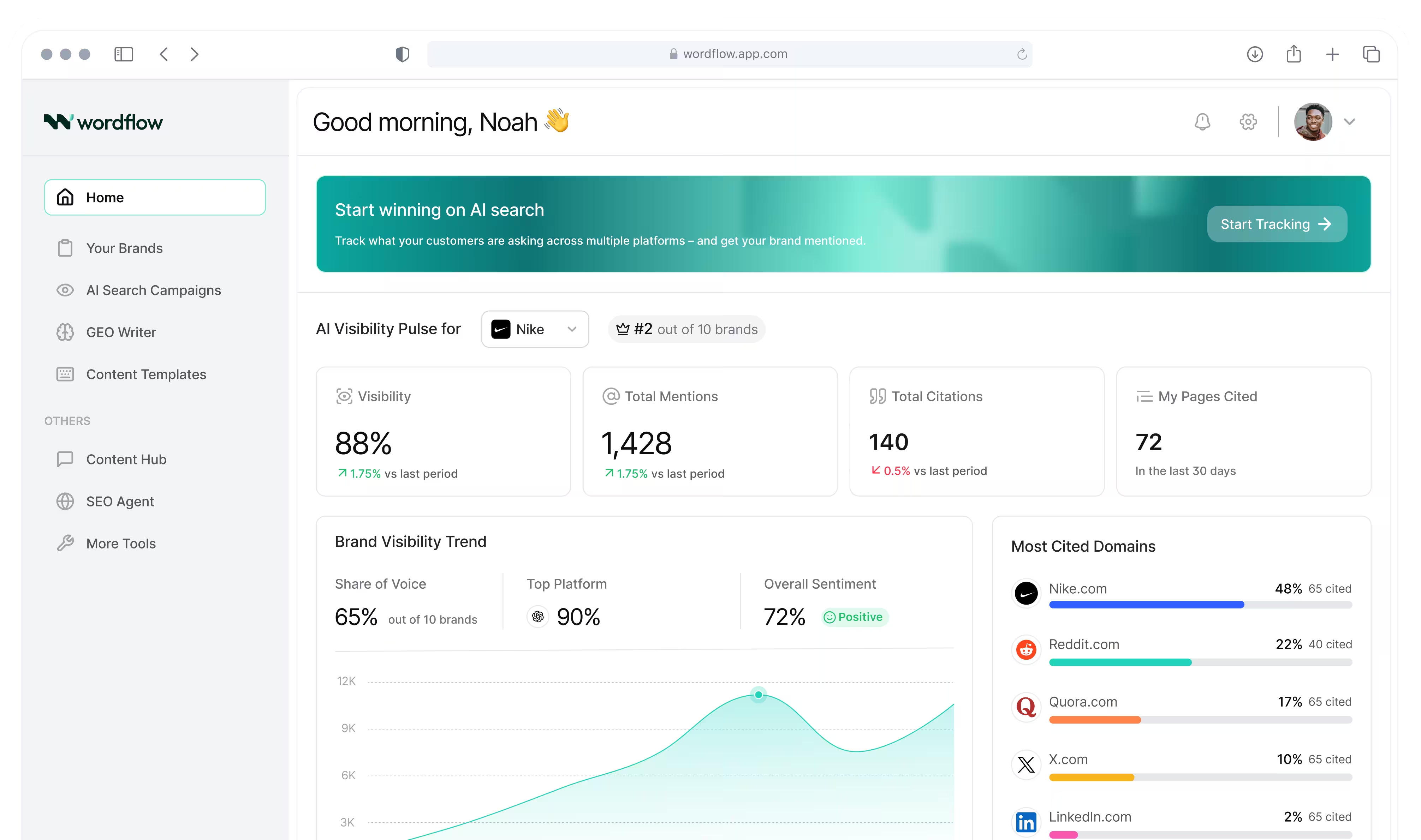
Several AI visibility tools now expose QFO and track subqueries at each fan-out instance. At Wordflow, we’re working towards simulating QFO for individual subqueries and providing marketers with the right tools to leverage those subqueries immediately across various workflows.
- Use a query extractor
Several bookmarklets now extract fan-out subqueries, though these only work on specific browsers for certain answer engines.
- Pull the subqueries from Devtools
The most direct method involves using Chrome DevTools to inspect the network response in chat sessions where an answer engine has used web search. Several step-by-step approaches- searching the relevant JSON response or the network payload - have already been documented.
How to get cited in AI answers using Query Fan-Out insights
Once you’re able to extract QFO subqueries, here’s one approach that you can use to get your brand cited more often in AI answers.
Step 1: Start with your list of prompts
A practical trick we’ve tried is to feed a list of landing pages into an assistant and ask it to infer likely prompts. Treat the list of prompts as a starting hypothesis, then validate as you go along.
Naturally, you should only consider prompts that trigger web search in answer engines. This would exclude prompts that can be answered by simple, factual responses. Focus instead on prompts that are more likely to trigger product shortlists and comparisons.
Some examples would include:
- Best tools for [job to be done]
- [Category] alternatives
- [Brand] vs [brand]
- Best [category] for [segment]
- Evaluate [vendor] for [use case]
Note as well that AI answers do not appear for prompts that edge close to decision-making in highly-regulated industries. We’ve covered this in a previous writeup here.
Step 2: Run each prompt across multiple answer engines
Next, run the prompts across multiple answer engines, repeating them several times to identify recurring query patterns and citations.
Step 3: Extract the fan-out queries and cluster them
Collate the fan-out queries and cluster them by intent. Wordflow currently groups prompts by five different intents that closely mirror marketing objectives, but the idea is that the intent clusters should provide you and your team with actionable takeaways.
Step 4: Check the SERPs for the fan-out, not the prompt
For each fan-out query, do a manual check in Google (or any other relevant search index) to see (1) which pages the answer engines have cited, and (2) what kind of content format is cited the most for the particular subquery.
Step 5: Update existing content or create new ones
Once you know the fan-out patterns you’re missing, you need to decide how to cover them without creating a mess of overlapping pages.
A simple rule works well in practice:
- If the fan-out is a close variant of an existing page, update the page with a tight section that answers the drifted query directly.
- If the fan-out represents a distinct intent, create a dedicated page.
Close variants usually include things like “2026” modifiers, synonym shifts, or slightly different phrasing that still maps to the same job to be done. Distinct intents usually include comparison pages, alternatives pages, requirements pages, and pricing explainers.
Best practices for working with Query Fan-Out
While identifying QFO subqueries is useful to marketers, we should be careful not to mis-identify or overstate its value.
Firstly, QFO is not the same as ranking in a search engine. There has been much debate over why pages ranking well for certain keywords in Google fail to show up in AI answers - this isn’t because the answer engine uses a completely different ranking system. Rather, it’s because the answer engine is looking up a slightly different query. How “slightly different” the prompts are warrants further study, as even with a certain degree of semantic difference, it is possible for the same brands to show up in the majority of answers.
Secondly, we would caution against tying QFO observations to conversion metrics. It is still unclear how answer engines form the fan-out subqueries, or even how many permutations of subqueries are created. Instead, treat QFO as a deeper visibility insight and identify which pages and which answer engines surfacing your brand to users.
Lastly, schema appears to have no effect on QFO. While schema aids in machine readability, it’s not a direct replacement for informational clarity, nor is it by default a trust signal that answer engines look out for. Optimize for QFO by sticking to content best practices instead.
Read More
What is AI SEO or GEO? Why it matters for your brand, and how is it different from traditional SEO?
Talks about what AI SEO is, what the different terminologies mean, and how companies could utilise it.
How Generative AI Is Rewriting the Rules of Search
Explore the shift from SEO to GEO and how to stay visible in a world of AI-generated search responses.
How to measure your brand's presence inside AI conversations
AI visibility doesn't have to be a guessing game. Here's what the data tells us so far.
Artifical Intelligence.
Real Results
Ready to transform how you market? Start your unlimited free trial today and experience the advantage Wordflow brings to your results.