.png)
June 29, 2026
Why Use AI Search Monitoring Tools? (And How to Choose One)
AI search monitoring helps brands track how they appear in AI-generated answers, including mentions, citations, sentiment, and competitor visibility.
If you've been tracking your website traffic in Google Analytics and wondering why your brand seems to be losing ground, you're not imagining it. A new discovery channel has opened up, and most analytics platforms are not reporting on it at all.
In Q1 2026 alone, AI search platforms received more than 27.4 billion visits, with more than 16.8 billion attributed to ChatGPT. Growth is also spreading across the wider AI search ecosystem. During the same period, Claude visits grew by 50%, Gemini by 37%, and Grok by 24% compared with the previous period.
That matters because more buyers are discovering brands inside AI-generated answers before they ever reach a search results page or website. AI search monitoring tools exist to close that gap. This post explains what they do, why you need them, and what to look for when choosing one.
What Is AI Search Monitoring?
AI search monitoring is the practice of tracking how your brand appears in AI-generated answers across platforms like ChatGPT, Perplexity, Google AI Overviews, Gemini, Claude, Grok, and DeepSeek.
When someone asks an AI engine "what's the best project management tool for agencies?" or "which accounting software is popular in Australia?", those platforms generate an answer. They mention brands, cite sources, and assign implicit rankings, often without the user ever visiting a search results page. AI search monitoring tools track those answers systematically: how often your brand is mentioned, what the AI says about you, which competitors are named instead, and which sources the AI trusts enough to cite.
It is distinct from traditional SEO monitoring, which tracks keyword rankings on Google. It is also distinct from brand mention tracking tools, which scan for your brand name across the open web. AI search monitoring is specifically focused on the answers AI engines generate: the visibility you have inside those responses, not just the links you rank for outside them.
Why use AI search monitoring tools?
AI search is changing how people discover brands, but most analytics and SEO tools were not designed to track that shift.
AI search monitoring helps marketers understand what is happening inside AI-generated answers and uncover insights that traditional reporting tools often miss.
1. Your existing tools do not show where AI discovery is happening
Google Analytics, Search Console, and traditional SEO platforms were built for a search journey where a user enters a query, sees a results page, clicks a link, and lands on your website.
That journey still matters. But it is no longer the only way buyers discover brands.
When someone asks ChatGPT, “What is the best project management tool for a remote team?” and the answer recommends your competitor, that moment of influence may never appear in GA4. There is no impression, no click, no session, and no referral source you can easily attribute.
The impact may only appear later as a branded search, a direct visit, or a lead that seems to come from nowhere. Without AI search monitoring, you cannot see whether AI engines are introducing your brand to buyers or sending that demand to someone else.
2. AI-referred traffic is small, but often high intent
AI search does not always drive large volumes of referral traffic yet. In many categories, the bigger impact happens before the click.
When users do arrive from AI platforms, they often come with more context. They have already asked a question, compared options, read a generated answer, and formed a shortlist before visiting your site.
That makes AI search different from standard organic discovery. It is not just another traffic source. It is a decision-shaping layer that can influence which brands buyers trust before they ever reach a website.
AI search monitoring tools help you understand whether your brand is present in those moments, how often you are mentioned, and whether the answers position you positively, neutrally, or unfavourably.
3. Citation opportunities are limited
AI-generated answers do not cite every possible source. They usually surface a small set of pages, brands, reviews, articles, forums, or third-party references that the system considers useful for the query.
That means visibility is partly a competition for citation space.
If your competitors are repeatedly cited for high-intent prompts and your brand is missing, they are not just getting traffic. They are shaping the evidence AI systems use to answer future buyer questions.
This is where citation tracking matters. It shows which sources AI engines trust in your category, which of your pages are being used, and where competitors are earning visibility without you.
4. Keyword rankings do not equal AI visibility
Ranking well on Google is still valuable. But it does not guarantee that your brand will appear in AI-generated answers.
A page can rank well in traditional search and still be ignored by AI systems if the content is difficult to extract, lacks clear structure, or does not answer the prompt directly. On the other hand, a page that is not in the top organic position may still be cited if it provides a clear, specific, and trustworthy answer.
This changes the feedback loop for SEO and content teams.
Instead of only asking where they rank, marketers also need to understand whether they are mentioned in AI answers, how often competitors appear, which sources AI systems cite, how their brand is described, and what content gaps are stopping them from being included.
AI search monitoring tools create that missing feedback loop.
5. The cost of waiting builds over time
AI visibility is not built from one article or one campaign. It comes from repeated signals across your own website, third-party sources, review platforms, comparison content, forums, and trusted industry references.
The longer a competitor appears consistently in AI answers, the stronger their perceived category presence becomes. They earn more mentions, more citations, and more visibility across the prompts buyers are using to compare solutions.
For marketers, this makes AI search monitoring less of a reporting exercise and more of a strategic early-warning system.
It helps you see where your brand is being overlooked, where competitors are gaining ground, and which actions are most likely to improve your presence in AI-generated answers.
What AI Search Monitoring Tools Actually Track
The best AI search monitoring tools track four interconnected dimensions.
Visibility.
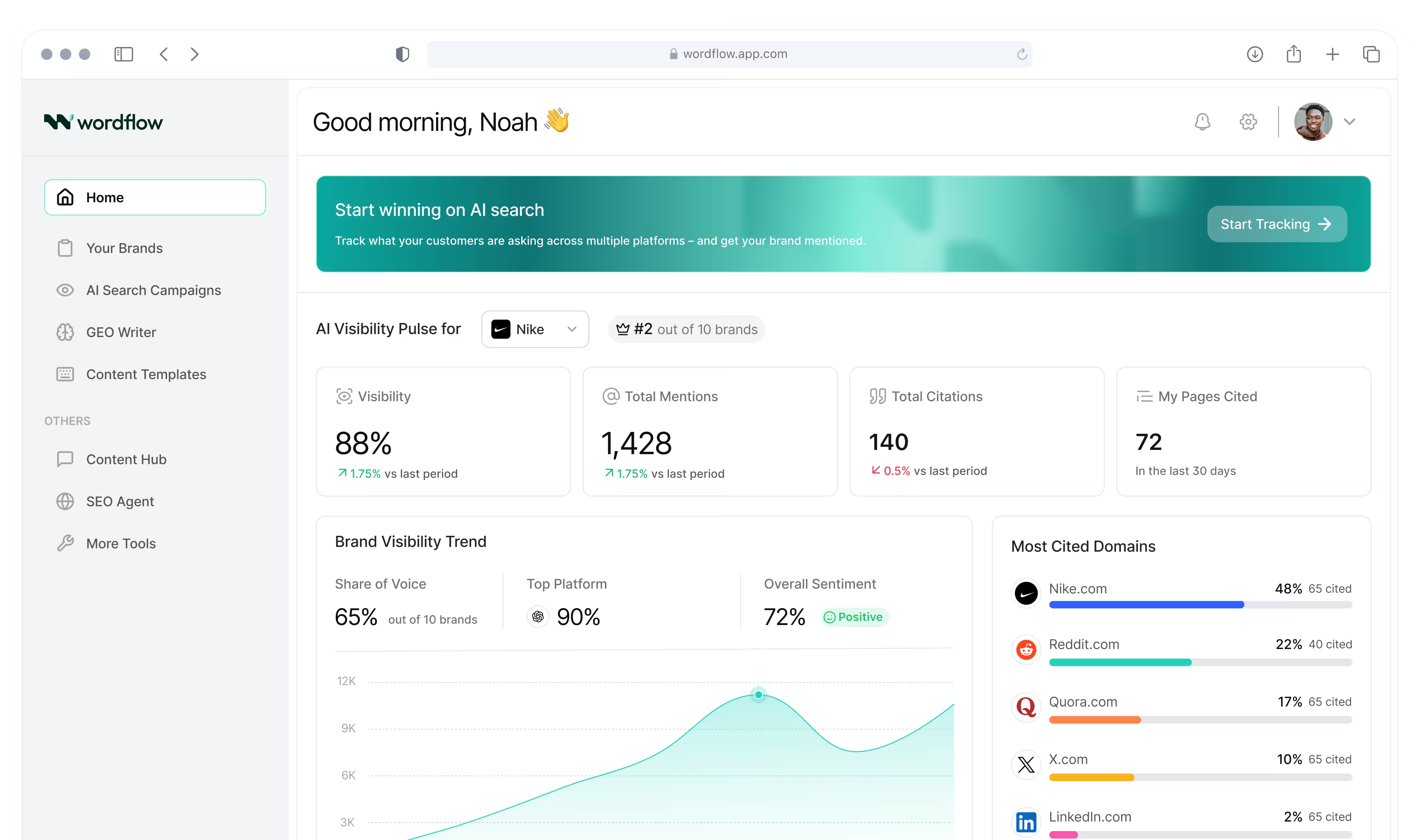
How often does your brand appear in AI-generated answers for the queries your buyers are asking? This is typically expressed as a visibility score: mentions divided by total responses analysed. A brand that appears in 4 of every 10 AI answers for its tracked queries has a 40% visibility score. Low visibility means buyers are discovering competitors instead of you.
Share of voice.
Visibility is most meaningful in context. If you appear in 40% of AI answers but your main competitor appears in 70%, you are losing the conversation even though you are technically present. Share of voice compares your visibility against the competitors AI mentions on the same queries, giving you a relative position rather than just an absolute score.
Sentiment.
Not all mentions are equal. AI engines do not just cite brands; they characterise them. "Best for enterprise" and "can be expensive for small teams" are both mentions, but they land differently on a buyer in the buying journey. AI search monitoring tools should track sentiment alongside visibility, flagging whether AI is describing your brand positively, neutrally, or negatively, and surfacing the specific language being used.
Citations.
AI platforms back up their answers with sources. When an AI recommends a product, it often cites a review site, a comparison article, or the brand's own website as the basis for that recommendation. Citation tracking shows which of your pages are being pulled into AI answers, which trusted third-party domains are influencing AI's perception of your brand, and, crucially, where your competitors are cited in responses that do not include you. That last category is a direct roadmap for content and PR investment.
Why AI search monitoring matters now
AI search is no longer a small side channel that marketers can afford to ignore.
In Q1 2026, average monthly users across AI search platforms increased by 6%, rising from 851 million in Q4 2025 to 904 million. Over the same period, average monthly Google users saw a slight decrease of 0.26%, which sits within a normal margin of error.
Google still remains much larger, but the gap is narrowing. In Q1 2026, the ratio of Google users to AI search users was 3.5 to 1, compared with 4.9 to 1 in Q1 2025. Google also continued to grow year on year, with global monthly average unique visitors increasing by 3.6% and more than 100 million additional monthly visitors compared with the same period last year.
The takeaway is not that AI search has replaced Google. It is that search behaviour is becoming more distributed. Buyers are still using Google, but they are also turning to ChatGPT, Perplexity, Gemini, Claude, and other AI search platforms to compare options, understand categories, and form shortlists.
For marketers, this creates a measurement problem. Traditional SEO tools can still show Google rankings, impressions, and clicks. But they do not show whether your brand is being mentioned, cited, or recommended inside AI-generated answers.
What to Look for in an AI Search Monitoring Tool
The category is still early. Some tools focus narrowly on one AI platform; others cover a handful of metrics without connecting them to action. Here is what matters when evaluating your options.
Coverage across multiple AI engines.
A monitoring tool that only tracks ChatGPT is telling you a fraction of the story. Buyers use ChatGPT, Perplexity, Gemini, and Google AI Overviews interchangeably depending on the task. If your tool cannot show you performance across all major platforms, you are working with a partial view. Look for tools that cover at least the five to seven platforms your buyers actually use.
Competitor benchmarking as a first-class feature.
Your raw visibility score means little without context. The right tool should show you competitor performance on the same queries, not as an add-on but as a core part of the reporting view. Share of voice, per-platform competitive breakdowns, and query-level competitor analysis should all be available without custom setup.
Sentiment and citation tracking.
Visibility alone is a quantity metric. Sentiment tells you the quality of what AI says about you. Citation tracking tells you why AI says it, and where to invest to improve it. A monitoring tool without these dimensions is only giving you half the picture.
Prompts and topics that match how buyers actually search.
The queries AI monitoring tools track need to reflect real buyer behaviour: not generic keywords, but the natural-language questions buyers ask AI engines at different stages of their decision. Good tools should help you build a tracking set that covers your category, your specific use cases, and your competitive landscape. Better tools auto-suggest those queries based on your brand and goals.
A connection between insight and action.
This is the most important distinction in the category. A monitoring dashboard that shows you where you are losing is useful. A platform that converts those findings into a prioritised work queue (specific content to create, sources to target, technical issues to fix) is substantially more valuable. The gap between knowing and doing is where most teams stall. Your AI search monitoring tool should help close it.
Reporting cadence that matches your workflow.
Daily tracking is not always necessary, but weekly tracking at minimum is essential for meaningful trend data. A tool that only refreshes monthly cannot help you respond to competitive movement or measure the impact of content you have published.
Multi-brand support if you manage more than one.
Agencies and in-house teams managing multiple brands or product lines need a platform architecture that can handle that. Single-brand-only tools create an operational ceiling very quickly.
How Wordflow turns AI search monitoring into published content
Most AI search monitoring tools stop at the point of diagnosis. They show where your brand is missing, where competitors are appearing, and which prompts you are losing visibility on. The harder part is knowing what to do next.
Wordflow was built to close that gap. As Australia’s first AI search and content engineering platform, it connects AI visibility monitoring with the content workflow needed to improve it.
On the monitoring side, Wordflow tracks how your brand appears across seven AI answer engines: ChatGPT, Claude, Perplexity, Gemini, Google AI Overviews, Grok, and DeepSeek. The data comes from live prompt simulations, not cached datasets. Wordflow sends your tracked questions directly to each platform and records the answer generated at that moment.
This gives teams a clearer view of what a buyer would actually see when asking that question today, rather than relying on data pulled from a crawler or index. All paid plans include weekly tracking across all seven engines, while Pro and Agency plans can upgrade selected prompts to daily tracking.
The reporting is designed to show both visibility and context. Teams can see visibility and share of voice on the Overview dashboard, review the full AI answer text for every tracked query, analyse sentiment and citations, and compare competitor performance on the same prompts. On Pro and Agency plans, Wordflow Insights adds a weekly audit of what AI says about your brand, where visibility has improved, and where it has dropped.
Every prompt is also tagged by intent, including informational, commercial, problem-solving, or transactional. This helps teams understand whether visibility is breaking down at the research, comparison, or decision stage of the buyer journey.
Where Wordflow goes further is in turning those findings into content action. The Action Hub converts visibility gaps into prioritised tasks, so teams can see which pages, topics, or prompts need attention first. From there, one click opens the task in GEO Writer with the relevant context already loaded, helping teams create content that is structured for the exact query they want to improve.
Brand Profiles, Audience Personas, and Compliance Checklists are applied during the writing process, so content stays aligned with brand, audience, and regulatory requirements from the first draft. Wordflow also connects with Claude through an MCP connector, allowing teams to pull live campaign data into the tools they already use without opening the dashboard every time.
For teams that want to understand their current position before building a full campaign, Wordflow’s Free Scan provides a no-account-required snapshot across ChatGPT, Perplexity, and Google AI Overview. It shows where your brand stands today, then Wordflow helps turn those insights into the content needed to improve visibility over time.
Run your free AI visibility scan →
Summing Up
AI search monitoring tools exist to answer a question GA4 cannot: how does AI describe your brand, and who does it recommend instead of you?
The category matters because AI-generated answers are now a primary discovery layer for buyers across almost every vertical. Brands that monitor and act on AI search data are closing the gap before it shows up in revenue. Brands that are not monitoring yet are falling behind without knowing it.
When you are evaluating tools, look for coverage across the major AI engines, competitor benchmarking built in from the start, sentiment and citation tracking alongside raw visibility, and, most importantly, a clear path from the data you collect to the actions you take.
If you are starting from scratch, a free scan is the quickest way to understand where you currently stand.
Wordflow is Australia's first AI search and content engineering platform. AI Search Campaigns and GEO Writer are available on Starter, Pro, and Agency plans; Wordflow Insights is available on Pro and Agency. 14-day free trial included.
Read More
How Generative AI Is Rewriting the Rules of Search
Explore the shift from SEO to GEO and how to stay visible in a world of AI-generated search responses.
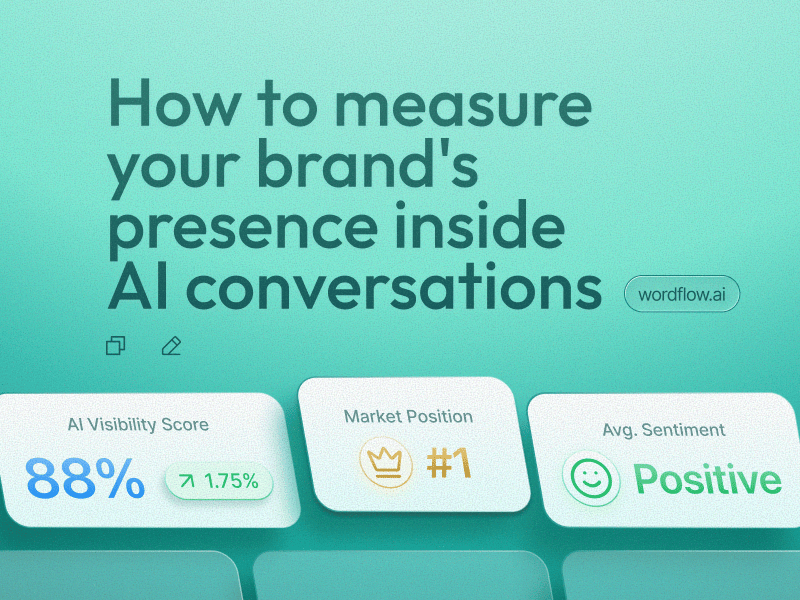
How to measure your brand's presence inside AI conversations
AI visibility doesn't have to be a guessing game. Here's what the data tells us so far.
How to Spot Content Gaps in AI Answers
AI search visibility changes content gaps from missing keywords and pages to missing inclusion, positioning, proof, and decision-ready answers that AI can confidently summarize.
Artifical Intelligence.
Real Results
Ready to transform how you market? Start your unlimited free trial today and experience the advantage Wordflow brings to your results.