09 November 2026
Winning AI search: how to get mentioned in ChatGPT's answers
How does ChatGPT pick which brands to recommend? See the six steps it follows, how it differs from Perplexity and Gemini, and what to fix first
When we ran 180 real buyer questions about electric cars through seven AI engines, BYD was named more than any other brand in Australia. Yet when buyers asked AI to choose, it recommended BYD without a caveat just 4% of the time. Being known by AI and being recommended by it are two different jobs, and ChatGPT is where most buyers in Australia and Singapore put that question first.
This first post in Winning AI search, our series of single-engine deep dives, explains how ChatGPT decides which brands to name, using OpenAI's documentation, independent studies and our own tracking, and what that means for AI SEO for ChatGPT. New to the topic? Start with our guide to what AI SEO (also called generative engine optimisation) is.
Key takeaways
- ChatGPT leads AI search in Australia and Singapore, but not Hong Kong. It has about 44% of AI chatbot use in Australia and 39% in Singapore, but under 10% in Hong Kong, where it isn't officially available.
- ChatGPT starts from what it already knows. It forms a view from its training data before it looks at any search results, so an outdated or missing picture of your brand puts you behind from the first word.
- It only searches some of the time, and rewrites the question when it does. Your pages need to match the more specific searches ChatGPT runs, not just the buyer's original sentence.
- Most of what it cites about you isn't your own website. In our BYD teardown, BYD's own site made up only 8.5% of the citations about it.
- The answer is shaped around the buyer. Who they are, where they are and what they stress (a budget, a city, being new) decides which brands make the shortlist, so track prompts that sound like your real buyers.
Why ChatGPT is the first engine to focus on in AI SEO
ChatGPT is the first engine to focus on because, in two of our three core markets, it's the AI tool buyers use most. But its lead isn't the same everywhere, and other engines find information in quite different ways, which is why AI search advice for one engine doesn't automatically work for another.
StatCounter's October 2026 data on AI chatbot use shows how much the picture changes by market:
Source: StatCounter, October 2026 (Australia, Singapore, Hong Kong).
In Australia, ChatGPT has a clear lead. In Singapore, Gemini is almost level with it. In Hong Kong, ChatGPT is a minor player, because Hong Kong isn't on OpenAI's list of supported countries and territories (OpenAI Help Center). Gemini and Perplexity carry most of the AI search there, even though searches for 'ChatGPT HK' still run to around 3,600 a month, according to Semrush.
The engines also behave differently. Perplexity is built around searching the live web for each answer, and Gemini sits inside Google's ecosystem. ChatGPT mixes what it already knows with searches it chooses to run, and that mix is what the rest of this post unpacks.
How does ChatGPT decide which brands to recommend?
ChatGPT works through six steps every time it answers a buyer: it reads who's asking, forms a first answer from what it knows, decides whether to search, rewrites the question into its own searches, picks sources and writes an answer shaped to the buyer. Your brand can be picked up or dropped at each one.
1. It reads who's asking
How it works. ChatGPT interprets a question in the context of the person asking: earlier messages in the chat, their approximate location from their IP address and, if memory is on, what it has saved about them. OpenAI's own example: someone who has said they're vegan and live in San Francisco asks for nearby restaurants, and ChatGPT searches for 'good vegan restaurants San Francisco' (OpenAI Help Center). Two buyers asking the same question can get different shortlists.
What this means for you. A generic prompt like 'best trading app' doesn't tell you much. Track prompts written the way your buyers actually ask, with who they are built in: 'I'm new to investing. What's the best app for buying US stocks?' That's how we write the questions we track in Wordflow, because the brand ChatGPT picks for a beginner can be quite different from the one it picks for an experienced trader.
2. It forms a first answer from what it already knows
How it works. OpenAI says ChatGPT considers 'model responses generated by ChatGPT before it considers any new search results' (OpenAI Help Center). That first view comes from how the web described your brand when the model was trained. Some sources carry extra weight: OpenAI has a data partnership with Reddit (OpenAI, 2024), and in Profound's analysis of 680 million AI citations, Wikipedia made up 47.9% of ChatGPT's ten most-cited sources (Profound, 2025).
The trade-off is age. Training data stops at a cutoff, so a new brand, product or rebrand may not exist in ChatGPT's built-in knowledge, while an old price or retired product can linger. When ChatGPT does search, it leans towards newer pages: an Ahrefs study of 17 million citations found ChatGPT's citations were on average 458 days newer than Google's organic results (Ahrefs, 2025). But freshness alone doesn't win; many cited pages are more than a year old.
Perplexity works the other way round. When we asked 11 AI engines which app an Australian beginner should use to buy US stocks, 9 of Perplexity's 10 sources were one broker's own pages, and that broker became its pick. ChatGPT picked a different app, drawing on a wider mix of sources.
What this means for you. On ChatGPT, the story the web told about you months ago matters. Use one clear description of what you do, who you're for and where you operate, everywhere, and clean up outdated versions of you. These changes reach ChatGPT's built-in knowledge slowly, which is why the search steps below matter in the meantime.
3. It decides whether to search
How it works. ChatGPT searches 'automatically when your question would benefit from current information', but not every time. In one test of 400 questions, only about 35% triggered a search (AI+Automation, 2026). Questions that mention a place, a year, a price or the 'best' options are more likely to trigger one. Perplexity, by contrast, searches for almost everything.
What this means for you. Broad questions may be answered from memory alone, so step 2 decides whether you appear. Specific buying questions usually trigger a search, so your website and the sites that mention you decide it. You need both.
4. It rewrites the question into its own searches
How it works. OpenAI says ChatGPT 'typically rewrites your query into one or more targeted queries', then sends 'additional, more specific queries' after reviewing the first results. Its own example turned a question about cancer drugs into 'CCR8 immunotherapy drug development 2025', adding a specific term and the year. The same AI+Automation test found ChatGPT ran an average of 4.7 searches each time it searched. Google's AI Mode works in a similar way, a process known as query fan-out.
They also shape what gets cited. Ahrefs analysed 1.4 million ChatGPT prompts and found that cited pages had titles much closer in meaning to the buyer's question than pages ChatGPT read but ignored, and closer still to its rewritten searches. Pages with plain-language URLs were cited 89.8% of the time, against 81.1% for those without (Ahrefs, 2026). Treat these correlations as strong signals, not rules.
What this means for you. A café owner's question might become 'best accounting software for cafés Australia 2026' and '[brand] vs [brand] for small business'. If you don't have a page whose title and URL match searches like these, a competitor's comparison article will. Our guide to query fan-out shows how to map them.
5. It picks sources from search partners and trusted sites
How it works. ChatGPT search 'sometimes partners with other search providers', and OpenAI points to Microsoft's and Shopify's privacy policies for how they handle queries. For local questions it can use 'trusted third-party providers' such as business listings. To read pages it uses the OAI-SearchBot crawler, and 'sites that are opted out of OAI-SearchBot will not be shown in ChatGPT search answers' (OpenAI). A couple of small tests suggest Bing plays a bigger part than Google, but the evidence is thin.
Ahrefs found about 88% of the pages ChatGPT cited came from its search results, and that Reddit made up 67.8% of the pages it read but didn't cite: 'It learns from the crowd, then cites another institution.' Its favourite sources also move. Semrush saw ChatGPT's citations of Reddit fall from close to 60% of responses to around 10% in mid-September 2025, while Wikipedia dropped from about 55% to under 20% (Semrush, 2025). Other engines lean on different sources: in Profound's data, Reddit made up 46.7% of Perplexity's top sources, against 11.3% for ChatGPT.
Our own tracking shows how much of this happens away from your website. In our BYD teardown, BYD's own site was only 8.5% of what AI cited about it; Australian motoring sites such as drive.com.au and carsales made up most of the rest. In regulated categories, ChatGPT goes to the regulator first: asked which app a Singapore beginner should use to buy Bitcoin, it checked the Monetary Authority of Singapore's register before naming an app.
What this means for you. Your site has to be reachable, but most of the work is getting accurately covered on the review sites, publications, directories and registers ChatGPT trusts for your category, and on more than one, because those preferences shift.
6. It writes an answer shaped to the buyer
How it works. ChatGPT 'ranks search results using multiple factors intended to help users find relevant, reliable information', and OpenAI says 'placement is not guaranteed'. It focuses on whatever the buyer stressed: given a budget, 'ChatGPT will focus more on price' (OpenAI Help Center). It also hedges. In our Australian US stocks test, ChatGPT named its pick, then added: 'It isn't automatically the cheapest choice, though.' Asked about Bitcoin apps in Hong Kong, it wouldn't pick one at all: 'I'd start by comparing HashKey Exchange and OSL.'
What this means for you. Being named isn't the win; being recommended without a 'but' is. Make your prices, who you're best for and where you operate easy to find, so ChatGPT has the facts to match you to the buyer's details. Then track how often you're recommended, not just mentioned.
Our Prompt Scanner examples come from single runs on 2 to 3 November 2026. They show how engines behave, not how they always answer, and they're not financial advice.
How deep research and agent mode change the picture
Not every ChatGPT answer comes from a quick chat. Deep research and agent mode look at far more of the web and can act on it, and both reward brands with detailed, usable websites.
Deep research
How it works. OpenAI says deep research can 'find, analyze, and synthesize hundreds of online sources' over 5 to 30 minutes and 'cite specific sentences or passages from its sources'. It names shoppers researching 'cars, appliances, and furniture' as a use case (OpenAI, 2025). The buyer gets a detailed report rather than a shortlist.
What this means for you. Publish the detail a researcher would want, such as specifications, pricing, comparisons and case studies, and write each passage so it makes sense on its own. Thin websites give deep research little to quote.
Agent mode
How it works. ChatGPT agent uses 'a visual browser that interacts with the web through a graphical-user interface', clicking and filtering its way through sites. OpenAI's examples include buying ingredients, booking travel and analysing competitors (OpenAI, 2025).
What this means for you. A site an agent can't navigate is a site it can't choose. Keep prices, availability and key actions visible without logins where possible, label buttons and forms clearly (OpenAI has said ARIA labels help its agent), and check that bot protection doesn't block it.
Why doesn't ChatGPT recommend your business?
When ChatGPT leaves a brand out, the brand has usually dropped out at one of the six steps. There are five common reasons, and each leaves a clue you can spot by asking ChatGPT a few questions in a temporary chat and opening Sources on the answers.
The last reason often costs the most. In our BYD teardown, 70% of AI's answers comparing BYD with its rivals came with a 'yes, but', such as the shorter warranty or BYD's short track record in Australia.
How to get ChatGPT to recommend your business
If you're wondering how to get your business on ChatGPT, or how to appear in ChatGPT's answers for the questions that matter to you, fix the reasons above in order. Start with the first one that applies to you.
1. Get into ChatGPT's first draft
- Write one description and use it everywhere. Say what you are, who you're for and where you operate in one or two plain sentences, on your homepage, About page, LinkedIn, directories and press boilerplate.
- Pair your name with your category and location if it's also an everyday word or shared with another company.
- Clean up old versions of you. Redirect retired product pages and ask directories and partners to update outdated descriptions.
- Build a footprint on the sources ChatGPT learns from. Add a Wikidata entry where appropriate, only pursue Wikipedia if you genuinely meet its notability rules, and take part honestly in Reddit communities where buyers compare options.
2. Make sure ChatGPT's searches can reach you
- Allow OAI-SearchBot. Check your robots.txt file and make sure your host or CDN allows OpenAI's published search-bot IP addresses. Cloudflare, which handles traffic for around 20% of the web, now blocks AI crawlers by default on new domains (Cloudflare, 2025).
- Get indexed in the major search engines. Submit your sitemap and check for errors in both Google Search Console and Bing Webmaster Tools.
- Make key content readable without scripts. So can ChatGPT crawl websites? Yes, but only what's in the page itself. Vercel found none of the major AI crawlers ran JavaScript (Vercel, 2024), so prices, product details and locations should be in the page's HTML.
3. Answer the searches ChatGPT actually runs
- Map the searches behind your key questions. For each buyer question, list what it becomes once ChatGPT adds the category, type of customer, location, budget and year.
- Build pages for the searches you're missing. Comparison pages, 'best [category] for [type of customer]' pages, city pages, 'alternatives to [competitor]' pages and a clear pricing page are the most common gaps.
- Match titles and URLs to those searches, and show when each page was last updated.
- Lead each section with the answer, then the detail.
4. Get on the sites ChatGPT trusts for your category
- Find your category's sources. Note which review sites, publications and threads come up again and again in Sources. Our guide to tracking AI citation sources shows how.
- Get accurate coverage on them. Complete your review-site profiles, pitch the publications that keep appearing and ask 'best of' authors to consider you, with evidence.
- Give them something to cite, such as original data or research.
5. Match the details buyers ask for
- State your prices, who you're best for and where you operate in plain words. A brand with no visible pricing gives ChatGPT nothing to compare.
- Encourage reviews that mention specifics, such as value or setup time. ChatGPT summarises reviews into labels like 'Budget-friendly'.
- If you sell products, feed ChatGPT your product data. Shopify merchants are included through Shopify Catalog with 'no additional work', and others can apply to send a direct product feed (OpenAI Help Center).
- If you serve local customers, keep your listings accurate across the major directories and maps services.
Expect 2 to 3 weeks of regular tracking before drawing conclusions, and 4 to 8 weeks before changes start to show in ChatGPT's search-based answers. Changes to its built-in knowledge take longer.
How Wordflow tracks your brand in ChatGPT
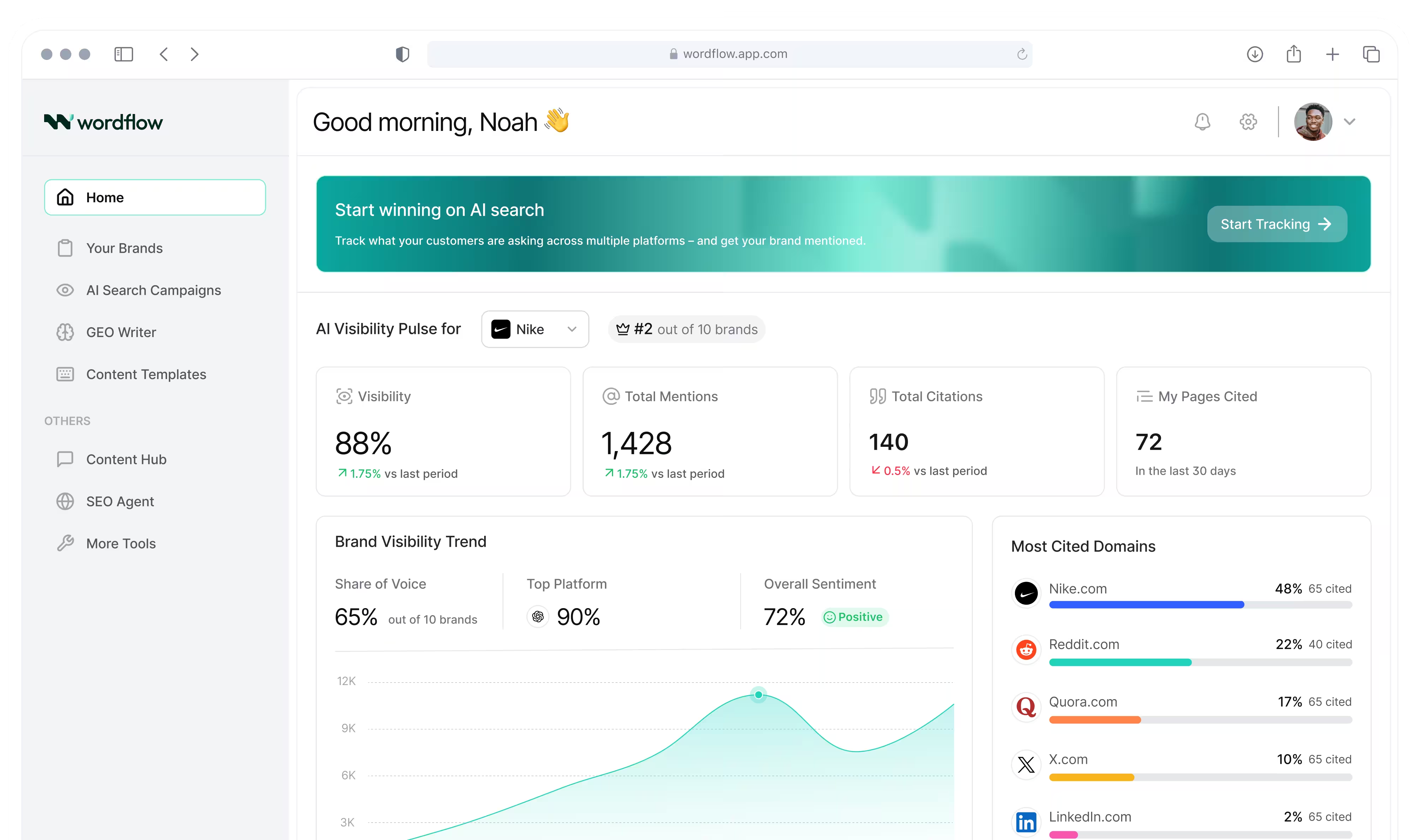
Wordflow shows you what ChatGPT and other AI engines say about your brand, which sources they rely on and what to fix first.
The Prompt Scanner tests a single buyer question across several AI engines at once, the way we ran the examples in this post. An AI Search Campaign tracks a fixed set of buyer questions every week across up to 11 AI engines, depending on your plan, with ChatGPT included. You can view your visibility in ChatGPT on its own, see which pages it cites, and track how accurately it describes you and how often it recommends you. Insights points to what's holding you back, and the Action Hub turns it into a task list.
Start a 14-day trial or book a demo and we'll walk you through it.
ChatGPT and AI SEO: frequently asked questions
Can ChatGPT recommend my business?
Yes. Whether it recommends yours depends on what it already knows about you, whether its searches can reach your site, and whether the sources it reads describe you clearly for that buyer's needs.
Does ChatGPT use Google or Bing to search the web?
OpenAI says ChatGPT search 'sometimes partners with other search providers' and refers users to Microsoft's and Shopify's privacy policies. It doesn't publish a full list, so the safest approach is to be well indexed in both Google and Bing.
Does blocking GPTBot stop my site appearing in ChatGPT?
No. GPTBot is OpenAI's training crawler, and blocking it only opts your content out of model training. Appearing in ChatGPT search is controlled by OAI-SearchBot, and sites that block it won't be shown in ChatGPT search answers.
Can I pay to be recommended by ChatGPT?
Not in its answers. OpenAI says ChatGPT's product results are 'selected independently' and 'are not ads', and that ads are shown separately from product results.
Is ChatGPT available in Hong Kong?
Not officially. Hong Kong isn't on OpenAI's list of supported countries and territories, and ChatGPT had only about 10% of AI chatbot use there in October 2026. If you sell into Hong Kong, track Gemini and Perplexity as well as ChatGPT.
Next in Winning AI search: how Perplexity finds its answers, and how to get mentioned there.
Read More
GEO vs. SEO in 2026: what actually changes (and what doesn’t)
Learn how GEO (Generative Engine Optimization) differs from traditional SEO in 2026.
How Generative AI Is Rewriting the Rules of Search
Explore the shift from SEO to GEO and how to stay visible in a world of AI-generated search responses.
How AI workflows are changing the way marketing works
Discover how a unified AI workspace transforms fragmented marketing operations into a seamless, efficient, and collaborative environment for better results.
Your buyers trust AI answers.
Make them pick you.
See what AI engines say about your brand today, and what it takes to be the brand they recommend.