A few notes on where each one came from and where they differ.
Because the way buyers search has changed. They now ask AI to research products, compare options and shortlist who to buy from, long before they land on a website or book a sales call.
Traditional search hands back a list of links and lets the buyer choose. AI does the choosing. If your brand shows up in the answer, you're in the running. If it doesn't, strong rankings may not get you into the conversation.
So the goal has shifted. Success used to mean a click to your site. Now it also means being named, described accurately and recommended inside the answer. The question for marketers is no longer just "are we ranking?" It is "does AI include our brand, and how does it represent us?"
The most common assumption is that AI SEO is just an extension of SEO, and that a strong Google ranking guarantees a place in AI answers. The evidence says otherwise.
In a Semrush analysis of 200,000 keywords (2024, vendor study), the top organic result appeared in just 46% of Google AI Overviews. Across the top ten results, only 20% to 26% of AI Overview links matched the organic rankings. A page can rank first on Google and still be missing from the AI answer.
Here is how the two compare side by side.
|
Traditional SEO |
AI SEO (GEO) |
| What the searcher gets back |
A ranked list of pages |
One synthesised answer |
| The unit that matters |
The page |
The passage (a self-contained chunk of text) |
| What you compete for |
Rankings and clicks |
Mentions, citations, share of voice and recommendations |
| Where the answer comes from |
Mostly your own site |
Trained knowledge, third-party sources and competitor content |
| Who does the comparing |
The user, across several sites |
The AI, inside the answer |
| What success looks like |
Traffic to your site |
Being named and recommended in the answer |
You're optimising for different machines
SEO focuses on the signals a search engine's ranking algorithm uses. Google crawls and indexes pages, then ranks them by keywords, links, relevance, site health and authority. So SEO teams optimise for keywords, backlinks, technical health and content depth.
AI doesn't rank pages in the same way. It reads, interprets and decides. It looks information up before it writes, works out what your brand is, and places you in context next to the topics, audiences and competitors it associates you with. SEO signals still feed into this, but they don't explain how AI builds its answers.
Does SEO still matter?
Yes. SEO and AI SEO share foundations, including accessible content, clear structure and authority. Many AI engines also lean on search indexes when they retrieve information. This isn't about replacing one with the other. Wordflow's position is Search Everywhere Optimisation, with SEO and GEO running in parallel and both measured. We go further into where the two overlap in GEO vs SEO in 2026: what actually changes and what doesn't.
How do AI engines decide which brands to include?
To influence AI answers, you need to know where they come from. Every answer blends two sources.
1. Trained knowledge. This is what the model learnt when it was built. It is frozen at a cut-off date, often a year or more behind, and you can't edit it directly. It's also a big source of "it described us wrong", because the model may be working from an outdated picture of your brand.
2. Live retrieval. This is what the engine pulls from the open web the moment someone asks. It includes your owned content (your site, blog and documentation), third-party signals (reviews, forums, news and editorial) and competitor content, which fills whatever gaps you leave.
How much an answer leans on each depends on the engine, the product and the question. You can't rewrite what a model was trained on. You can strengthen what it retrieves, interprets and verifies when a buyer asks. That second source is where AI SEO does most of its work.
AI has to retrieve, recognise and connect your brand
Before your brand can appear in an answer, the engine does three things.
It retrieves, then answers. A question about the "best running shoe" fans out into related searches for value, foot type, weather and intended use. The engine retrieves passages relevant to each and uses them as context for its answer. This is known as query fan-out and retrieval-augmented generation (RAG). It's why the individual passage matters, not just the page it sits on.
It recognises you. Named-entity recognition (NER) lets the engine work out from the surrounding context whether a name refers to a company, product, person or place. It's how AI tells Apple the company from apple the fruit. Thin or contradictory information about your brand makes that harder to get right.
It maps your meaning. AI turns the relationships between brands, topics, attributes and use cases into numbers called vectors, or embeddings. Once it recognises a brand, those numbers tell it what the brand sits near. For Apple, that's iPhone, MacBook and iOS. For your brand, it's whatever your name is most often mentioned alongside.
Your brand is a pattern of signals
To an AI engine, your brand isn't a website or a logo. It's a pattern built from every source that mentions you.
Consistent descriptions across your site, review profiles, directories, press coverage and community threads make you easier to place in the right category, next to the right audience and use case. Thin, outdated or conflicting descriptions weaken the pattern, or put you in the wrong category altogether. When a buyer asks a question, it activates part of that pattern. The stronger and more consistent your signals, the more confidently AI can describe and recommend you.
AI SEO strengthens the whole pattern, so AI can retrieve, understand and verify your brand wherever it looks.
Why is there no single AI to optimise for?
Because every engine can produce a different answer. AI engines differ in their training data, retrieval systems, source selection and citation behaviour, so the same buyer question can return a different shortlist on each one.
There are also more engines than most teams track. At least seven major engines operate in Western markets (ChatGPT, Gemini, Copilot, Perplexity, Claude, Grok and Meta AI), with several more in China, such as DeepSeek, Qwen and Doubao.
Vendor research from Profound gives a sense of how differently they behave. Its July 2025 study of 100,000 prompts found only 6% to 16% of citations overlapped between any two engines. Its May 2026 study of 2.64 billion citations found the number of sources cited per answer ranged from 6.6 on Gemini to 11.1 on Google AI Overviews and 15.2 on Google AI Mode. Treat these as directional, since they come from a single vendor, but the pattern is clear. Engines mostly cite different sources.
A brand can show up strongly on one engine and be absent from the next. Good AI SEO means tracking each engine separately and optimising for the mix, not trusting one platform or a single blended score.
What actually changes in your day-to-day marketing work?
Most of your SEO skills still apply. What changes is where you point them and how you measure the result.
| Traditional SEO habit |
AI SEO habit |
| Research keywords |
Research prompts, the full questions buyers ask AI, including comparisons, use cases and "best for" queries |
| Optimise the page |
Make each passage answer one question clearly and still make sense if it's quoted on its own |
| Build backlinks |
Earn mentions on the third-party sources AI already cites in your category, such as reviews, editorial and forums |
| Track rankings and clicks |
Track mentions, citations, share of voice, sentiment and recommendations, engine by engine |
| Check Google |
Check every engine your buyers use, on a fixed schedule |
| Leave brand consistency to the brand team |
Treat consistent descriptions everywhere as a visibility signal |
| Optimise for Googlebot |
Make sure key content is in the page HTML, because AI crawlers generally don't run JavaScript |
Two of these changes tend to surprise teams most.
The first is how much happens off your own site. Ahrefs research across 75,000 brands (2026, vendor study) found that around 89% of the time a brand appears in an AI answer, another website is doing the mentioning. Your PR, partnerships, review profiles and community presence are now part of your search strategy.
The second is who's involved. AI SEO can't sit with the SEO team alone. Content, PR, product marketing, customer success and social all shape the signals AI reads. The teams that make progress agree on one source of truth for how the brand is described, then make sure every channel says the same thing.
If you want to start with prompts, our guide that covers how to find the questions buyers actually ask. For the off-site side, see how to track AI citation sources.
How Wordflow measures and helps you act on AI SEO
Checking one engine by hand every few weeks won't show you the full picture. You need the same questions, asked across every engine, on a fixed schedule, so you can compare answers over time.
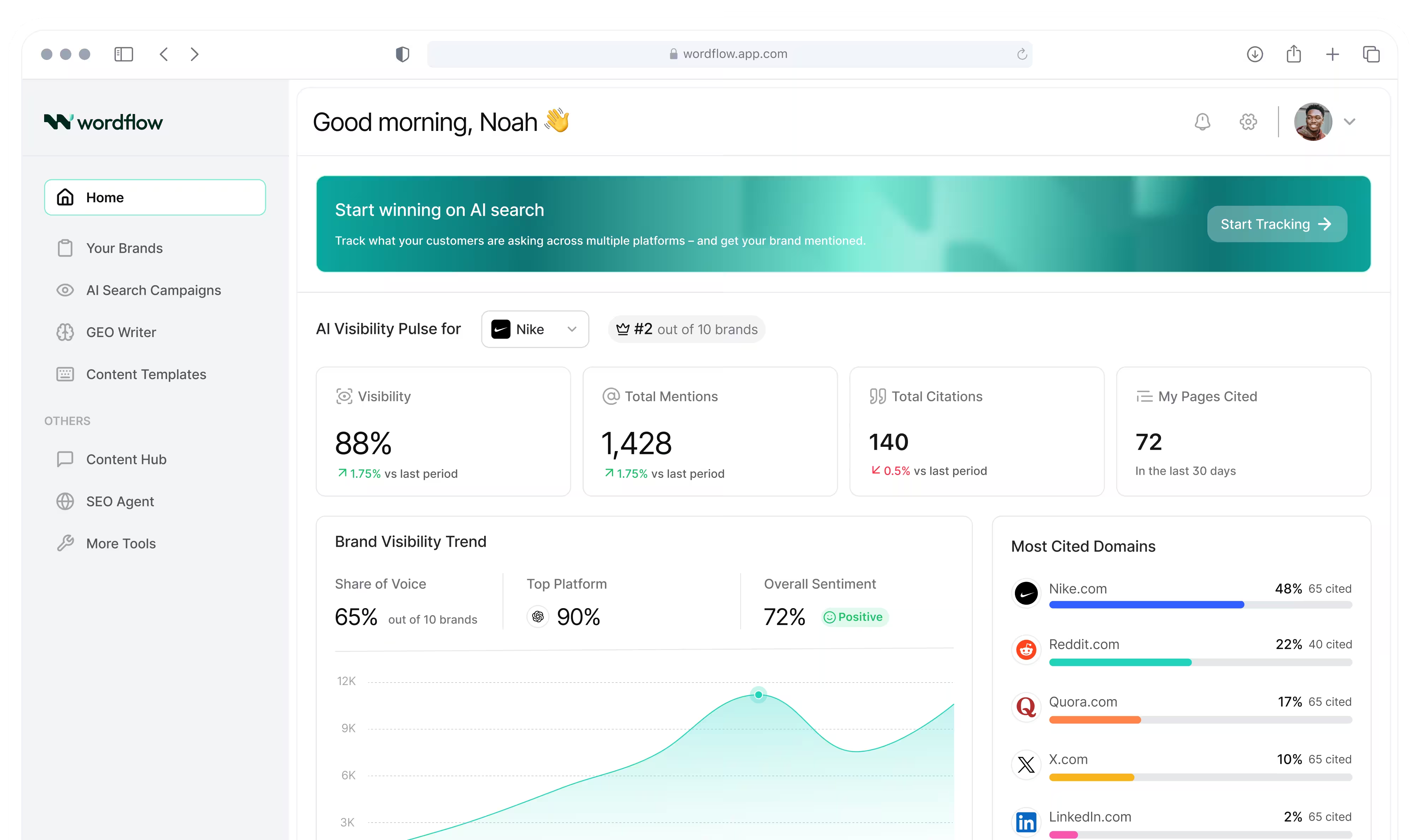
That's what Wordflow does. Wordflow is Australia's first AI search and content engineering platform. It runs the prompts your buyers ask across 12 AI engines, including ChatGPT, Claude, Perplexity, Gemini, Google AI Overviews, Grok and DeepSeek, weekly by default, and records every answer. From those answers, you can see:
- how often your brand is mentioned, and your share of voice against competitors
- which of your pages are cited, and which third-party sources AI trusts in your category
- how each engine describes your brand, and where that drifts from your own story
- where competitors are recommended instead of you, and whether AI recommends you outright or hedges
Collecting answers is only the first step. How they're analysed decides whether the results are useful. A raw mention count can hide the fact that you were named for the wrong reason, or named only for AI to add that a rival is better.
That's why Wordflow reads AI visibility as four layers that happen in order: Found, Understood, Cited and Recommended. A brand can pass one layer and fail the next, so the first job is finding which layer is holding you back. The Action Hub then turns those gaps into prioritised on-page, off-page and technical actions, and GEO Writer helps you produce on-brand content built to be cited.
Looking for an AI SEO agency or consultant?
Some teams would rather have specialists run the work. FlowManaged pairs the Wordflow platform with our GEO specialists, who set up your campaigns, build the content strategy and produce content from live prompt and citation data. It's the generative AI SEO service for teams that want structured execution without building an in-house function.
We're not a typical AI search optimisation agency. We're a software company with a specialist team that works in AI search data every day. If you're comparing AI SEO services in Melbourne, Sydney or anywhere else in Australia, or in Singapore, the questions to ask any agency or consultant are the same. Which engines do they track? How often? Do they measure recommendations, or only mentions? And can they show you the prompts and sources behind every recommendation they make?
Want to see where you stand first? Start on Wordflow's Free plan to track 25 prompts in ChatGPT each week and see where your brand appears.