June 17, 2026
When bots become the audience, how should marketers measure AI search visibility?
As AI search visibility becomes harder to measure through traffic alone, marketers need to track citations, brand mentions, and share of voice across AI-generated answers.
When bots become the audience, how should marketers measure AI search visibility?
For years, marketers have looked at website traffic and assumed they were looking at people. More sessions meant more interest. More pageviews meant more attention. More visitors meant more potential customers.
That assumption is becoming harder to make.
Cloudflare reported in June 2026 that automated systems now account for roughly 57% of web page traffic, meaning bots are now responsible for more traffic than humans. A growing share of what shows up in analytics is no longer made up of buyers browsing your site. It includes search crawlers, retrieval systems, AI agents, and monitoring bots that do not behave like customers, but still influence whether customers find you.
This changes the way marketers need to think about visibility. The question is no longer only "how many people found us?" It is also "how often do AI systems find, understand, cite, and recommend us?"
That is where AI search visibility comes in. It measures how often your brand appears, gets cited, and is recommended inside AI-generated answers. And in a web where machines increasingly shape discovery, traffic alone no longer tells the full story.
The audience changed, and part of it is now machines
For most of the web's history, visibility meant getting in front of people. You optimised for searchers, readers, buyers, and decision-makers. The goal was simple: help the right person find your brand.
That is still important, but it is no longer the whole picture.
Today, a growing part of discovery runs through systems that do not behave like customers. Search crawlers index your pages. AI crawlers pull information to help build answers in ChatGPT, Perplexity, and Google AI Overviews. Monitoring bots check whether your site is working properly. None of these systems are buyers, but they can influence whether a buyer ever hears about you.
The growth is hard to ignore. In 2025, automated traffic across the internet grew 23.51% year over year. AI-driven traffic grew by 187%, while agentic AI traffic grew by 7,851% year over year.
The practical takeaway is clear: bot traffic is no longer just noise to filter out of your analytics. Some of it is now part of the discovery layer that sits between your brand and your audience.
Why traditional metrics no longer tell the full story
Traffic, rankings, and clicks were built for a web where discovery and the visit happened together. Someone searched, clicked a link, and landed on your page. You could count it.
That link is increasingly disappearing. In a zero-click search, a buyer asks ChatGPT or reads a Google AI Overview, gets their answer, and never visits the source. The influence still happened. The click did not. Your traffic report shows a flat line while a competitor quietly wins the recommendation.
This is the gap. SEO metrics measure attention on your site. They cannot measure whether an AI engine understood your brand, trusted it, and named it in an answer that a buyer acted on. Visibility can now rise while clicks fall, and the old scorecard cannot see it.
What is AI search visibility, and how is it different from SEO?
AI search visibility is the likelihood that AI systems discover, understand, cite, and recommend your brand within the answers they generate.
Traditional SEO works to improve your rankings and organic traffic in search engines. AI search visibility works to improve how often AI engines mention and cite you when someone asks a question in your category.
The discipline of earning it has a name, or rather two. Generative engine optimisation (GEO) and answer engine optimisation (AEO) both describe the same shift: structuring your content and your authority so that AI-generated answers include you. Where SEO asks "do we rank for this keyword?", GEO asks "when a buyer asks AI about this problem, are we in the answer?"
Brand visibility in AI search is not a softer version of SEO. It is a separate measurement problem, and it needs its own metrics.
Which metrics should marketers track now?
Traffic, rankings, and conversions still matter. They show whether people are finding your site, engaging with your content, and taking action.
But they do not show the full picture anymore.
If buyers are discovering brands through AI-generated answers, marketing teams also need to understand how machines are interpreting their content. That means tracking visibility signals that sit outside traditional analytics.
AI citations
AI citations show how often AI engines reference your content as a source. A citation is important because it suggests the system trusts your content enough to use it in an answer.
Brand mentions in AI-generated answers
Brand mentions show whether your company is named when buyers ask category-level questions, even if there is no link to your website.
This matters because AI-generated answers can influence awareness, trust, and consideration before a buyer ever visits your site.
AI search share of voice
AI search share of voice shows how often your brand appears compared with competitors across AI search platforms.
This helps teams see whether they are gaining or losing visibility in the answers buyers are actually seeing.
Sentiment and accuracy
It is not enough to know whether AI mentions your brand. You also need to know whether it describes your brand correctly, clearly, and in a way that reflects what you want to be known for.
Crawl accessibility
Crawl accessibility shows whether AI crawlers can reach and read your key pages.
If they cannot access your content, it may never enter the systems that generate AI answers in the first place.
Reference frequency and visibility trends
AI search visibility changes as models, sources, prompts, and citation patterns shift.
A single snapshot can show where you stand today. The trend shows whether your content strategy is actually improving your presence over time.
Being seen versus being understood
This is the real shift. For years, the risk was being invisible to people. Now, a brand can also be invisible to machines.
That usually happens when content is difficult to interpret, authority signals are weak, brand information is inconsistent, or valuable crawlers are blocked from accessing key pages.
Being discoverable is no longer enough. Your content also needs to be clear, structured, and easy for AI systems to understand.
How to make your content machine-readable
If AI engines cannot understand your content, they are unlikely to cite it. That is true even when the content is useful, well-written, or already ranking in search.
Machine-readable content is the foundation of AI search visibility because AI systems need to identify what your page is about, who it is relevant to, and whether it can be trusted as a source.
In practice, this means writing in a way that is clear, specific, and easy to extract. Start with direct answers to the questions your buyers are already asking. Use headings that reflect real search or prompt behaviour. Structure each section so it can still make sense when a passage is pulled into an AI-generated answer.
It also means being explicit about your brand. AI systems need to understand who you are, what you do, who you serve, and how you fit into your category. The clearer those signals are across your site and other trusted sources, the easier it becomes for AI engines to recognise your brand as an entity.
Technical access matters too. If valuable AI crawlers are blocked from key pages, your content may not be available to the systems that shape AI answers.
This is the practical work of GEO. It is not only about publishing more content. It is about making your content easier for AI systems to find, read, understand, and cite.
How do you monitor AI search visibility?
The challenge is that most of these signals do not show up in Google Analytics or GA4. Those tools are built to measure human visits, not whether AI systems understand or recommend your brand.
To see how your brand appears inside AI-generated answers, you need AI search monitoring built for that specific job.
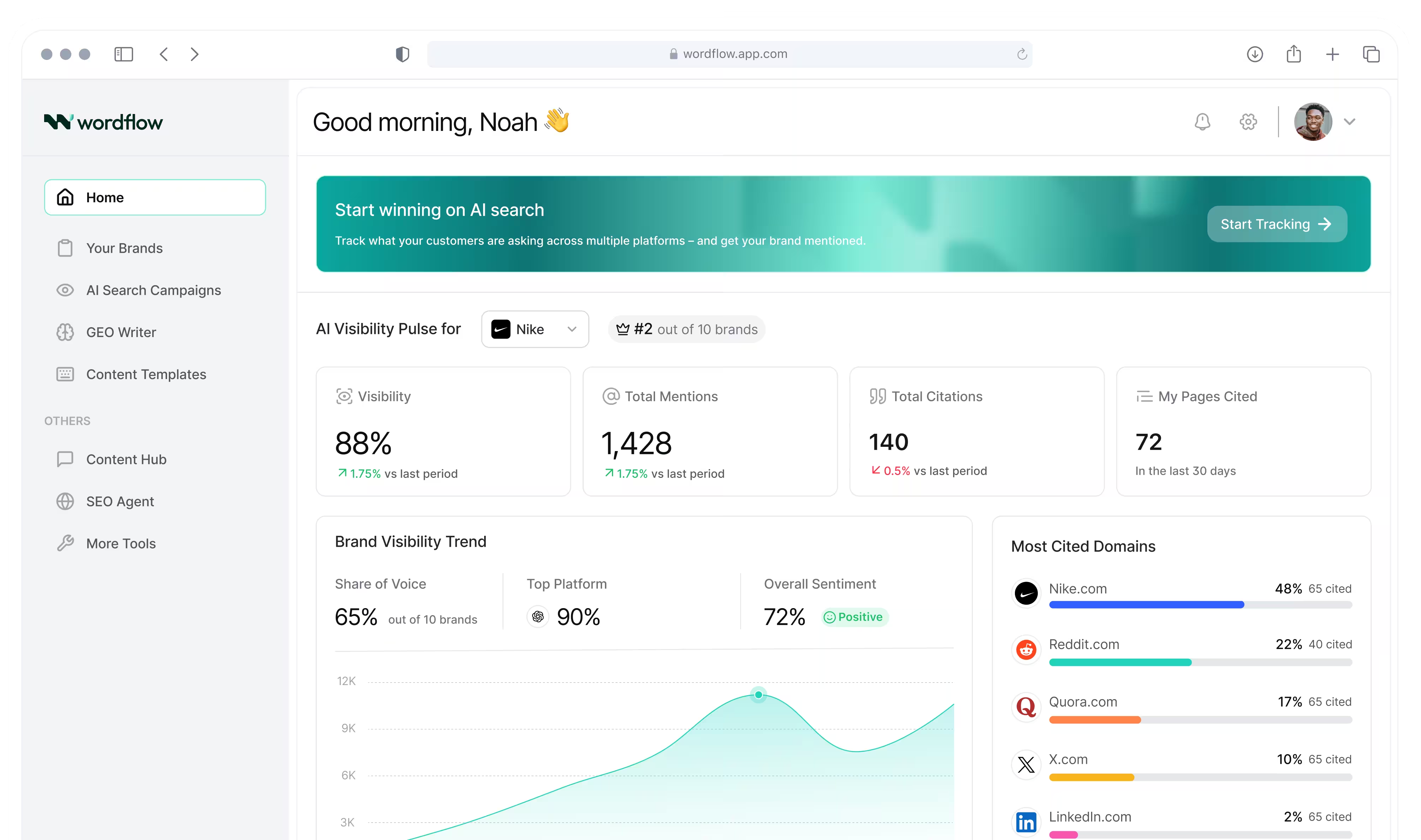
An AI search visibility checker helps you track which prompts trigger answers about your brand, which pages get cited, how your share of voice compares with competitors, and whether the sentiment is accurate. It shows whether AI engines are simply finding your content, or actually using it in the answers buyers see.
When choosing a tool, look for coverage across multiple AI engines, not just ChatGPT. You also want citation tracking, share-of-voice reporting, prompt-level insights, and sentiment analysis, rather than a simple presence score.
This is what Wordflow is built to do. Wordflow tracks your brand across seven AI engines, including ChatGPT, Claude, Perplexity, Gemini, Google AI Overviews, Grok, and DeepSeek. It reports your Visibility Score, Share of Voice, citations, and the prompts behind them, so you can see where your brand appears, where it is missing, and what content needs to be created or improved.
That turns AI search visibility from a guess into something marketers can measure, monitor, and act on.
The brands that win will be the easiest to understand
If bots now outnumber humans online, the challenge is no longer only about being seen. It is about being understood, trusted, and recommended by the machines sitting between your brand and your buyers.
The brands that succeed in the next phase of the web will not be the loudest. They will be the easiest for AI engines to find, read, and cite. Measuring AI search visibility is how you find out whether you are one of them yet.
See where your brand stands. Run a free scan at wordflow.ai/free-scan and get a picture of how you show up across ChatGPT, Perplexity, and Google AI Overview in about two minutes.
Wordflow is Australia's first AI search and content engineering platform. AI Search Campaigns, GEO Writer, and Wordflow Insights are available on Starter, Pro, and Agency plans. 14-day free trial included.
Read More
GEO vs. SEO in 2026: what actually changes (and what doesn’t)
Learn how GEO (Generative Engine Optimization) differs from traditional SEO in 2026.
How Generative AI Is Rewriting the Rules of Search
Explore the shift from SEO to GEO and how to stay visible in a world of AI-generated search responses.
How AI workflows are changing the way marketing works
Discover how a unified AI workspace transforms fragmented marketing operations into a seamless, efficient, and collaborative environment for better results.
Artifical Intelligence.
Real Results
Ready to transform how you market? Start your unlimited free trial today and experience the advantage Wordflow brings to your results.