September 12, 2026
Why Your Brand Ranks on Google but Does Not Show Up in AI Answers
Learn why strong Google rankings do not always lead to AI visibility and how to improve your brand mentions across leading AI search engines.
Your website is on the first page of Google. Organic traffic looks healthy, and your content covers the right topics. But when someone asks ChatGPT, Gemini or Perplexity to recommend a solution in your category, your brand is nowhere to be found.
This gap is larger than many marketers realise. In a February 2026 comparison of ten SaaS queries, Semrush found that only 44.3% of the pages ranking in Google’s top ten results appeared in at least one AI-generated answer across the four AI platforms it reviewed. The study was limited in scope, but it clearly demonstrates that ranking and AI visibility are not interchangeable.
Traditional search rankings and AI search visibility are connected, but they are not the same outcome. A page can perform well in Google and still fail to earn AI brand mentions because an AI engine could not retrieve the right information, understand what the brand offers, or find enough evidence to include it confidently.
Understanding that gap is the first step towards closing it.
What is AI visibility?
AI visibility describes how often and how accurately a brand appears in answers produced by tools such as ChatGPT, Claude, Perplexity, Gemini, Google AI Overviews, Grok and DeepSeek.
It is broader than whether an AI engine links to your website. A brand may appear as:
- A direct recommendation
- A cited source
- An example within an explanation
- A brand included in a comparison or shortlist
- A general mention without a link
These appearances matter because users increasingly ask AI questions that were previously typed into a search engine. Instead of searching for a broad phrase and reviewing several links, someone might ask, “Which platforms can help my team monitor how our brand appears in AI answers?”
The response may mention only a small set of companies. If your brand is absent, ranking well for a related keyword will not help you influence that particular discovery moment.
This is why AI search visibility needs its own measurement. Rankings and organic traffic still matter, but you also need to monitor mentions, citations, sentiment and share of voice across relevant prompts.
Tracking AI brand mentions shows whether the brand is actually present at these moments, rather than assuming its search rankings will carry across.
Want to see the bigger picture? Read The Complete Guide to AI Search Visibility in 2026 to learn what AI visibility means, how to measure it and where to improve.
How SEO and GEO measure different outcomes
Traditional SEO helps search engines crawl, understand and rank web pages. Its performance is commonly measured through keyword positions, impressions, click-through rates and organic traffic.
Generative Engine Optimisation, or GEO, focuses on whether a brand or its content becomes part of an AI-generated response.
The difference is easiest to understand by looking at the output.
With traditional search, the user sees a ranked selection of pages and chooses which one to visit. With AI search, the system interprets the prompt, gathers information and composes an answer. It decides which facts, sources and brands are useful enough to include.
That changes the unit of success:
- SEO asks whether your page earned a strong position and a click.
- GEO asks whether your information was retrieved, used, cited or associated with the right topic.
The SEO vs GEO conversation is therefore not about choosing one discipline over the other. It is about measuring two connected but different outcomes.
SEO remains an important foundation. Google states that its generative search features are rooted in its existing search ranking and quality systems. However, those foundations do not make every high-ranking page an automatic source for every AI answer. The user’s prompt, the information required and the system producing the answer all influence what gets selected.
Google’s guidance for generative AI search reinforces this point. Established SEO practices remain relevant, but visibility depends on creating useful, reliable content that can support the search experience.
Still wondering what GEO actually means for your content strategy? Learn how it works and where to begin in What Is GEO?.
Why high-ranking pages may be missing from AI answers
Ranking well on Google tells you that Google sees your page as relevant to a particular search. But that does not mean every AI platform will choose the same page or use the same sources.
So, even if a page performs well in traditional search, it may still be missing from AI answers. Here are some common reasons why.
The AI engine may not be able to access the page
Before it can use your content, it needs to be able to reach it. JavaScript problems, robots.txt rules, paywalls and other technical restrictions can prevent its crawler from accessing the page.
Crawler access can also differ between platforms. For example, OpenAI states that websites that opt out of OAI-SearchBot will not appear in ChatGPT search answers, although they may still appear as navigational links.
This means your site could be available to Google but not to another search system. OpenAI’s crawler documentation explains the controls for ChatGPT search visibility.
The page answers a keyword but not the full prompt
A page may rank for “project management software” because it is well optimised for that phrase. But an AI user might ask for project management software for a 20-person agency that needs client approvals, time tracking and a specific integration.
That is a much more specific request. The AI engine needs information that addresses several requirements at once. If the page only provides a broad product description, it may not contain enough detail to include the brand in its answer.
The useful information is difficult to isolate
Sometimes the answer is on the page, but it is buried inside a long introduction, vague product copy or a section that only makes sense after reading everything around it.
A person may be willing to read the full page to find the answer. An AI system needs to identify the relevant information quickly and understand it in context.
The page does not make the brand connection clear
A page can explain a topic well without showing how the brand fits into it. If the content does not clearly connect the company to its product, category and use case, the AI engine may understand the topic but still leave the brand out.
Other sources make a stronger case
AI answers can draw on more than a brand’s own website. Reviews, media coverage, industry directories, research, forums and other third-party pages can all influence which brands appear.
If these sources describe a competitor more clearly or consistently, that competitor may be easier for the AI engine to include.
How AI engines retrieve information
These AI engines do not all work in exactly the same way, and not every part of their process is public. However, there is a simple way to understand what generally happens: the system needs to access the content, retrieve the relevant information and decide whether to use it.
Access
First, can the system reach the page? This is where technical SEO matters. Pages should be crawlable, indexable, stable and free from unnecessary technical barriers.
Retrieval
Next, can the system find the information it needs? A detailed prompt may require several related searches rather than one exact keyword match.
Google, for example, says its generative AI search features can use “query fan-out”. This means the system may run several related searches to gather the information needed for one response. Each search may focus on a different part of the user’s question.
Selection and generation
Finally, is your content the clearest and most useful information to include? The system reviews the material it has found and selects what it will use to form the answer.
A page can be accessible and relevant but still not be chosen if another source gives a clearer, more specific or better-supported answer.
This is why there is no single change that guarantees visibility in AI search results. Technical access, relevance, content quality and brand clarity all need to work together.
Why passage-level content matters for GEO
AI engines do not always need an entire page. Often, they are looking for one clear piece of information that answers part of the user’s question.
So the question is not only whether your page covers the topic. It is also whether the most useful explanation is easy to find, understand and use.
A useful passage usually does four things:
- Answers one clear question
- Names the subject instead of relying on vague references
- Provides specific facts, examples or evidence
- Makes sense without requiring the reader to piece together information from several sections
Consider these two examples:
“Our platform gives teams better visibility and smarter insights.”
This could describe almost any software product. It does not tell the reader or the AI engine what the platform does, who it helps or what type of visibility it provides.
On the other hand, “Wordflow monitors brand mentions, citations, sentiment and share of voice across seven AI engines, helping marketing teams identify where their brands appear and where they are missing.”
The second version is much clearer. It identifies the brand, explains what the platform tracks, names the audience and describes the outcome. Both people and AI systems can understand it more easily.
Passage-level clarity does not mean cutting every article into tiny fragments or writing awkward copy for bots. Google explicitly says that artificial content “chunking” is not required for its generative search features.
The better approach is to write well-organised, people-first content with clear headings and sections that answer real questions directly.
That does not mean adding statistics or quotations wherever they fit. It means making important claims clear, specific and easy to verify.
How AI recognises and categorises your brand
Before an AI engine can recommend your brand, it first needs a clear picture of what your brand is and when it is relevant.
Imagine that a company describes itself as an “AI workspace” on its homepage, a “content automation platform” on LinkedIn and an “SEO writing tool” in industry directories.
None of those descriptions is necessarily wrong. But together, they make it harder to understand which category the company belongs to and what it should be known for.
The same problem can appear across products, locations and audiences. One page may say the platform is built for agencies, while another describes it as an enterprise product. A product page may mention a feature without explaining what it does. An old directory listing may still show a service the company no longer offers.
Clear brand categorisation starts with getting the basics right:
- The brand and product names
- The category the company belongs to
- The problems it solves
- The audiences and markets it serves
- Its main products, services and capabilities
- The evidence supporting its claims
This information should appear clearly across your main website pages, including the homepage, About page and product or service pages.
Relevant structured data can also give search systems clearer information about organisations, people and products, although it does not guarantee inclusion in an AI answer. Google’s structured data guidance explains how this markup can help search engines understand what a page describes.
Information beyond your own website matters too. Relevant coverage, reviews, partner pages, expert contributions and industry listings can reinforce what your brand is known for.
The aim is not to chase or manufacture mentions. It is to make sure accurate, consistent information appears wherever your business is genuinely featured.
How conflicting brand information weakens GEO visibility
AI systems often bring together information from several sources. When those sources say different things, it becomes harder for the system to know which version is correct.
Common conflicts include:
- Different descriptions of the company’s category
- Old product names appearing alongside new ones
- Inconsistent office locations or service regions
- Different claims about features, pricing or target customers
- Duplicate brand names that are not clearly distinguished
- Outdated third-party profiles ranking prominently in search
These inconsistencies will not automatically remove your brand from AI answers. But they can make the brand harder to understand and describe accurately.
The result might be no mention at all, an outdated description or a recommendation for the wrong type of search.
This is why a brand consistency audit should check more than tone of voice. Review whether your website and third-party pages communicate the same essential facts. Start with differences that affect your category, products, services, audiences and markets.
The clearer and more consistent this information is, the easier it becomes for both AI and traditional search engines to understand your brand.
How Wordflow tracks your visibility across seven AI engines
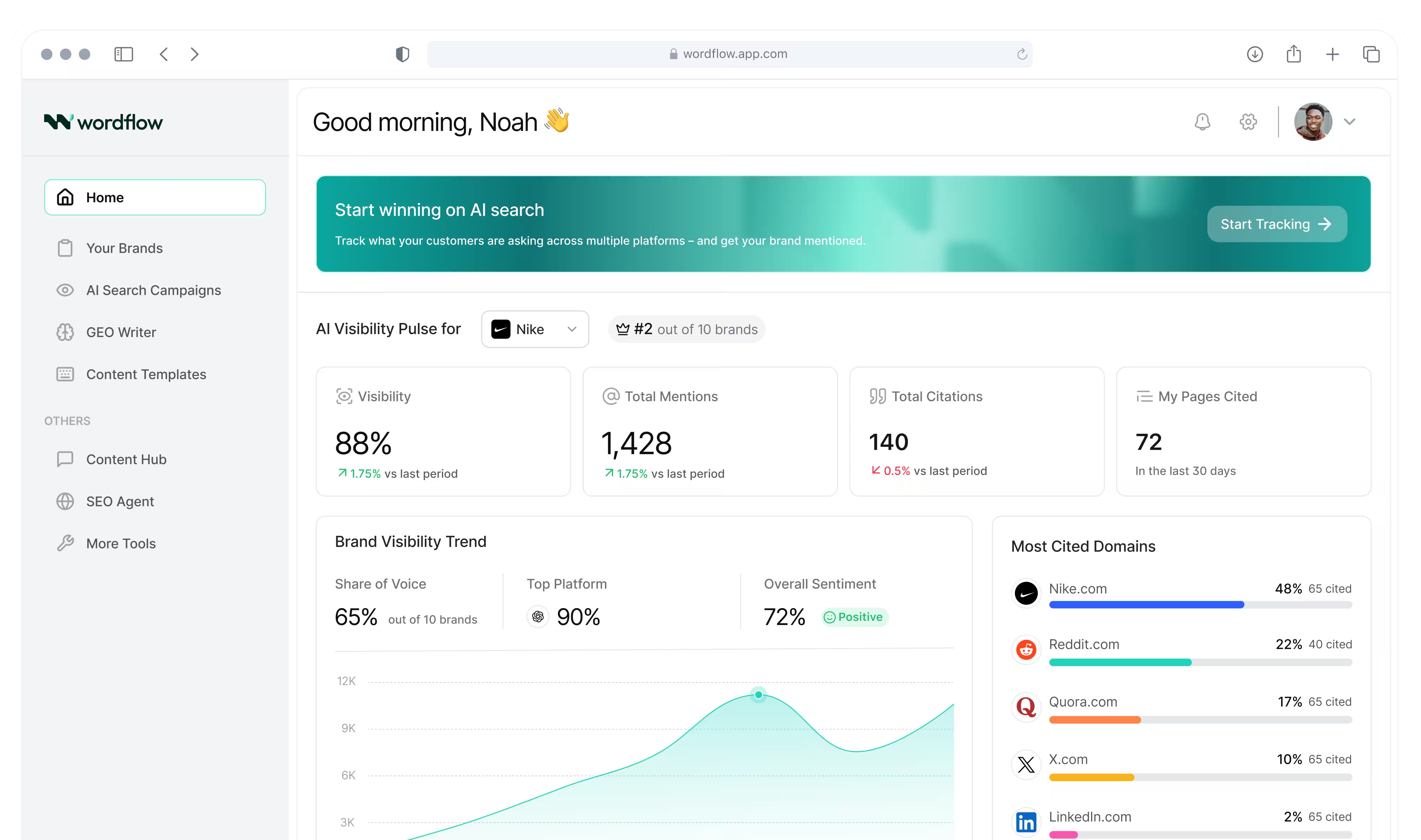
Traditional rank tracking cannot show whether your brand appears inside a generated response. Wordflow measures that layer directly by monitoring relevant prompts across ChatGPT, Claude, Perplexity, Gemini, Google AI Overviews, Grok and DeepSeek.
Wordflow uses live prompt simulations rather than relying on a static dataset. It records the answer produced at that time and shows where your brand appears, where competitors are being selected and which sources are being cited.
The platform brings those results together through metrics including:
- Visibility Score
- Share of Voice
- Brand mentions
- Citations
- Sentiment
- Prompt and citation gaps
This makes the difference between SEO and GEO measurable.
A team might discover that it ranks well for a category keyword but receives few AI brand mentions for high-intent comparison prompts. It might appear frequently in one AI engine but remain absent from the other six. It may also find that AI search engines mention the brand but describe its product inaccurately.
These are different problems and require different actions.
A technical access issue may need an SEO fix. A missing topic may require new content. An unclear association may call for stronger brand positioning across core pages. A competitor citation gap may show where the market has better third-party evidence.
Wordflow's AI search monitoring connects those signals to the prompts and sources behind them, helping teams decide what to address first.
Ranking is the foundation, not the whole picture
Strong Google rankings still matter. They help people find your content and give AI systems something useful to retrieve. But a first-page position does not automatically mean your brand will appear when someone asks an AI search engine for a recommendation.
To close that gap, make sure AI crawlers can access your site, keep important explanations clear and well supported, and describe your brand consistently across your website and other trusted sources. Then track where and how your brand appears across the AI engines your audience uses.
The goal is not to choose between SEO and AI visibility. It is to make sure your brand can be found in traditional search and understood well enough to be included in AI-generated answers.
Want to see where your brand appears today? Try Wordflow to track your mentions, citations, sentiment and share of voice across seven AI engines.
Read More
How Generative AI Is Rewriting the Rules of Search
Explore the shift from SEO to GEO and how to stay visible in a world of AI-generated search responses.
How to measure your brand's presence inside AI conversations
AI visibility doesn't have to be a guessing game. Here's what the data tells us so far.
How to Spot Content Gaps in AI Answers
AI search visibility changes content gaps from missing keywords and pages to missing inclusion, positioning, proof, and decision-ready answers that AI can confidently summarize.
Artifical Intelligence.
Real Results
Ready to transform how you market? Start your unlimited free trial today and experience the advantage Wordflow brings to your results.