October 11, 2026
AI Search Optimisation: How to Get AI to Recommend Your Brand, Not Just Mention It
AI can mention your brand and still recommend a competitor. Learn how AI search optimisation gets your brand recommended, not just mentioned.
Ask an AI assistant for the best option in your category and you might find your brand in the answer. That feels like a win. It often isn't.
Being mentioned and being recommended are two different outcomes. AI can name your brand and still point the buyer to a competitor, describe you with a caveat that quietly puts people off, or list you without ever linking to your site. If you're only counting brand mentions, you can't see any of that.
AI search optimisation, often called generative engine optimisation or GEO, is the work of closing that gap. It means making sure AI can find your brand, describe it correctly, treat it as a credible source and, finally, recommend it with confidence. This guide shows you what each of those looks like in a real answer, how to check where your brand stands today, and how to measure progress over time.
What Does It Mean to Be Mentioned by AI?
AI brand mentions are the simplest signal in AI search. Someone asks a question, the AI writes an answer, and your brand's name appears somewhere in it.
That's why mentions became the first number most teams track. It's easy to understand and easy to count. Ask ten questions, see your name in four answers, and you have a 40% mention rate. Plenty of tools will report exactly that, and if you monitor ChatGPT mentions by hand, it's usually the only thing you can realistically keep track of.
The problem is what a mention leaves out. It tells you that your name appeared. It doesn't tell you
- whether AI described your brand accurately
- whether it linked to your website as a source
- whether it actually suggested you, or named you only to compare you against someone it preferred
Picture a buyer asking for a project tool for a small team. The AI names five brands, recommends one, says another is 'fine for basic needs' and names yours last as 'an option some teams use'. Every one of those brands got a mention. Only one of them got the customer.
So mentions are a starting point for brand visibility in AI search, not the finish line. To see what really happened in that answer, you have to read it the way a buyer does.
What a Recommendation Actually Looks Like in an AI Answer
The clearest way to see the difference is to look at one answer and track what happens to each brand inside it.
Here's an example. A marketer asks an AI assistant, 'What's the best accounting software for a small creative agency?' The answer comes back like this:
For a small creative agency, Ledgerly is a strong choice, particularly if you bill by project, because it combines invoicing, time tracking and project budgets in one place [1]. Tallybook is popular too, though some users find its reporting limited as the team grows. Northcount comes up for agencies that want a very low monthly cost.
[1] ledgerly.com
Illustrative example only. This is a mock answer with fictional brands, not a real AI response.
Four brands could have appeared in that answer. Here's what actually happened to each one.
Three of those four brands would show up as 'mentioned' in a simple report. Only Ledgerly was recommended. And the answer itself shows why. Ledgerly got a clear reason and a citation. Tallybook got a compliment followed by a 'but'.
That 'but' has a name, and it's one of the most useful signals in AI search.
What Is Hedging, and Why Does AI Do It?
Hedging is when AI mentions your brand but adds cautious, qualifying language that stops short of a recommendation. It sounds like 'some users report', 'results vary', 'it depends on your needs' or 'it's an option, though…'.
Compare these two lines:
- Hedged: 'Tallybook is popular, though some users find its reporting limited.'
- Confident: 'Ledgerly is a strong choice for agencies that bill by project.'
Both brands are present. Only one is being chosen.
AI hedges because a bad recommendation costs it credibility. It doesn't read your star rating and trust it. It reads passages from across the web and weighs what they say. When the evidence about a brand is strong, consistent and positive across independent sources, AI is comfortable recommending it. When the evidence is thin, mixed or out of date, it protects itself by qualifying the answer or by recommending someone else.
For AI search optimisation, that makes hedging more than a tone problem. It's a diagnosis. A hedged mention tells you the AI has found you, understood you and considered you, but doesn't yet have enough trusted evidence to back you.
Hedging is also measurable. If you ask the same comparison questions over time and the caveats around your brand start to disappear, the evidence behind you is getting stronger. Fewer hedges usually show up before more reviews or more traffic do, which makes hedging one of the earliest signs that your AI search optimisation is working.
Hedging is only one way a brand falls short, though. To fix the right thing, you need to know which stage is breaking.
The AI Search Visibility Framework: Four Layers Between Mentioned and Recommended
Wordflow's AI Search Visibility Framework breaks AI visibility into four layers that happen in order: Found, Understood, Cited and Recommended. Each one asks a different question, is measured differently and is usually fixed by a different team.
The order matters. A brand can clear one layer and fail the next. More content won't help if AI can't access your pages. More outreach won't correct an inaccurate description. And more reviews won't help if AI can't find enough credible evidence about you in the first place.
Found: can AI access and retrieve your content?
Before AI can describe, cite or recommend you, it has to be able to retrieve the right information about you. This is the layer closest to traditional SEO, but it doesn't work quite the same way.
AI search doesn't rank whole pages. It pulls short, self-contained passages that answer a question, often from several related sub-questions at once. If your key information is buried, vague or only appears after JavaScript runs, AI may never see it. Vercel's analysis of more than 500 million AI crawler requests found that AI crawlers fetch JavaScript but generally don't run it, so content that loads that way can be missed entirely.
The fixes are practical. Put priority content in server-rendered HTML, write clear passages under descriptive headings, cover the related questions around each topic and keep your most important pages fresh. If you want more on how AI breaks one question into many, our guide to query fan-out covers it in detail.
Understood: does AI describe you accurately?
Being found doesn't guarantee being described correctly. AI builds its picture of your brand from everything it can read, including your website, directories, review sites, partner pages and media coverage. When those sources disagree, it can get your category, your audience or your strengths wrong.
AI can also be wrong with total confidence. A Columbia Tow Center study found that eight generative search tools miscited or invented sources in more than 60% of 1,600 queries. That study was about citations, but the lesson carries over. If the internet describes an old version of your brand, AI will repeat it.
The fix starts with one approved description of what you do and who you serve, used everywhere you control. Then you roll it out to the third-party profiles you don't control as directly.
Cited: does AI treat you as a credible source?
This is where many brands stall. AI can find you and describe you correctly, and you still don't appear in the answers that matter commercially. What's usually missing is independent authority.
An Ahrefs study of 75,000 brands found that about 89% of the time a brand appeared in an AI answer, another website was doing the mentioning, not the brand's own page. In most categories, AI keeps returning to the same small set of trusted sources, such as review platforms, community threads, industry publications and editorial roundups. Wordflow calls this your Citation Core.
The work here happens mostly off your own site. Find out which sources AI cites for your most important buying questions, then earn a real presence in those sources. Our step-by-step guide to tracking AI citation sources shows how to map them.
Recommended: will AI confidently suggest you?
This is the layer where hedging lives. Being included isn't the same as being chosen. AI recommends a brand confidently when the evidence about it is strong, consistent and positive. When it isn't, AI hedges or picks a competitor.
The strongest moves here are about evidence. Back your claims with named figures, direct quotes and first-hand testing. Ask customers for reviews that describe their role, their use case and the outcome, not just a star rating, because a detailed review gives AI something specific to repeat. Then set a baseline for how often AI recommends you and how often it hedges, so you can see the change.
Around all four layers sits one more consideration. AI agents are starting to browse, compare and complete tasks on a buyer's behalf, so your site also needs to be something an agent can actually use. That isn't a fifth layer. It's the environment the whole framework now sits in.
Knowing the layers is useful. Knowing which one is holding your brand back is more useful, and you can get a first read on that today.
Does AI Recommend My Brand? Four Quick Checks You Can Run Today
You don't need a tool to get a rough picture of where your brand stands. Each check below takes about five minutes and maps to one layer of the framework.
1. The Found check. Open your three most important pages with JavaScript turned off in your browser. If the main content disappears, AI crawlers probably can't see it either. This is a common blind spot for brands that rank well on Google, as we explain in why your brand ranks on Google but doesn't show up in AI answers.
2. The Understood check. Ask two different AI assistants what your brand does and who it serves. Compare the answers with how you describe yourself. Note anything outdated, vague or simply wrong, especially your category, your audience and your main point of difference.
3. The Cited check. Write down five questions a buyer might ask just before choosing a brand like yours. Run them and record every source the AI cites. If the same three or four websites keep appearing and you're not on any of them, you've found your Citation Core gap.
4. The Recommended check. Ask an AI to compare you with your two closest competitors. Run the same question three times, because answers change, and note who it recommends and any caveats attached to each brand. If your name keeps arriving with a 'but', that's hedging.
Keep your notes. Whatever you find is your starting point, and a weak starting point isn't a failure. What matters is whether it improves once you act.
These checks give you a first read. They won't give you a reliable one, and the reason why changes how you should measure everything that follows.
Why a One-Off Check Isn't Enough
AI answers aren't fixed. The same question can get a different answer from a different AI assistant on a different day or with slightly different wording. Your manual check is a single snapshot of something that keeps moving.
That causes three problems. You can't tell whether a result is typical or a one-off. You can't tell whether a change is a trend or noise. And you can't show anyone that the work you did made a difference, because you don't have a consistent 'before' to compare with.
Scale is the other issue. A useful picture usually means dozens of buying questions, several AI assistants and a regular schedule. Run 25 questions across six AI assistants each week, and you're reading 150 answers before you've compared a single competitor. One person doing that by hand will either cut corners or burn out.
Reliable measurement, and any AI search optimisation plan built on it, needs the same questions, asked the same way, across the same AI assistants, on a regular schedule. That consistency is what turns a pile of answers into something you can act on.
How to Measure Each Layer, Including Hedging
Once you're asking the same questions consistently, you can give each layer its own number. This is what people usually mean by measuring LLM visibility, and brand mentions alone won't tell you which layer is failing. So measure them all.
Read hedging next to recommendation rate, not instead of it. A brand whose hedging falls while its recommendation rate holds steady is building evidence, and the recommendations usually follow. A brand whose recommendation rate drops while hedging climbs is losing ground, often to a competitor whose evidence has become stronger.
Three habits make these numbers reliable. Record a baseline for every layer before you change anything. Keep your tracked questions fixed for the quarter so each period compares fairly with the last. And give it time. AI visibility is a trend metric, so expect two to three weeks of data before drawing conclusions and four to eight weeks before improvements show up in tracked answers.
Doing all of this by hand is possible for a handful of questions. Doing it well, across every layer and every AI assistant, is what a platform is for.
How Wordflow Shows Where AI Stops Recommending You
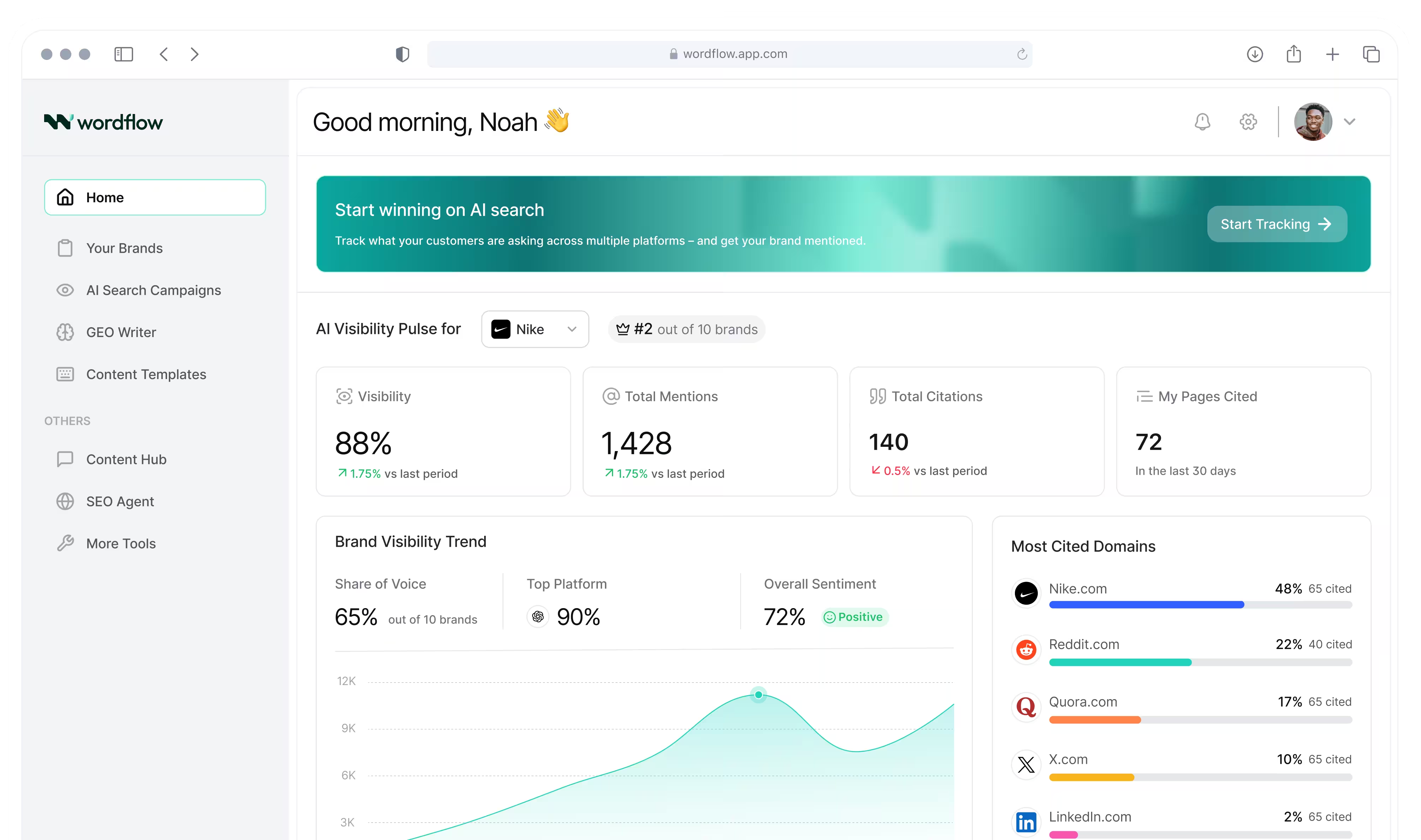
Wordflow is built around this framework. Instead of a single visibility number, it shows you which layer is holding your brand back and what to do about it.
Every data point comes from live prompt simulations. Wordflow sends your tracked questions to each AI platform and records the real answer at that moment, so you see what a buyer would see if they asked today, not what an old dataset says. Tracking runs weekly across up to 12 AI engines, depending on your plan, with an optional daily tracking add-on on Pro and Agency plans.
Three campaign types map directly to the layers.
- Category Visibility covers Found and Cited. It tracks unbranded categories and buying questions and reports your Visibility Score, brand mentions, pages cited, citation share and share of voice, plus an AI-readiness check.
- Brand Narrative covers Understood. It checks AI's description of your brand against your Brand Profile and flags off-story answers.
- Brand Comparison covers Recommended. It runs head-to-head and decision-stage questions and reports recommendation rate, recommendation share, sentiment and hedging.
The data doesn't stop at a dashboard. Missed Prompts shows the questions where competitors appear and you don't. Pages and Citations shows which sources AI trusts in your category and where you're absent. The GEO Action Hub then turns those findings into a prioritised list of on-page, off-page and technical fixes, and GEO Writer helps you create content for each gap, with your brand voice and compliance rules applied from the start.
The result is a clear answer to the question that matters. Not 'Are we mentioned?' but 'Where does AI stop choosing us, and what do we fix first?'
See where AI stops choosing your brand. Start with Wordflow to track every layer over time, or book a demo and we'll walk you through what AI is saying about your brand today.
Want the full framework, starter prompts and worksheets? Download the AI Visibility Playbook.
Read More
Artifical Intelligence.
Real Results
Ready to transform how you market? Start your unlimited free trial today and experience the advantage Wordflow brings to your results.