16 November 2026
Semrush alternatives for AI SEO: we compared 5 AI search tools (2026)
Our AI search team compared Wordflow, Peec AI, Profound, Otterly.ai and Scrunch on AI engines, tracking, features and price. Here's which fits your team.
Introduction
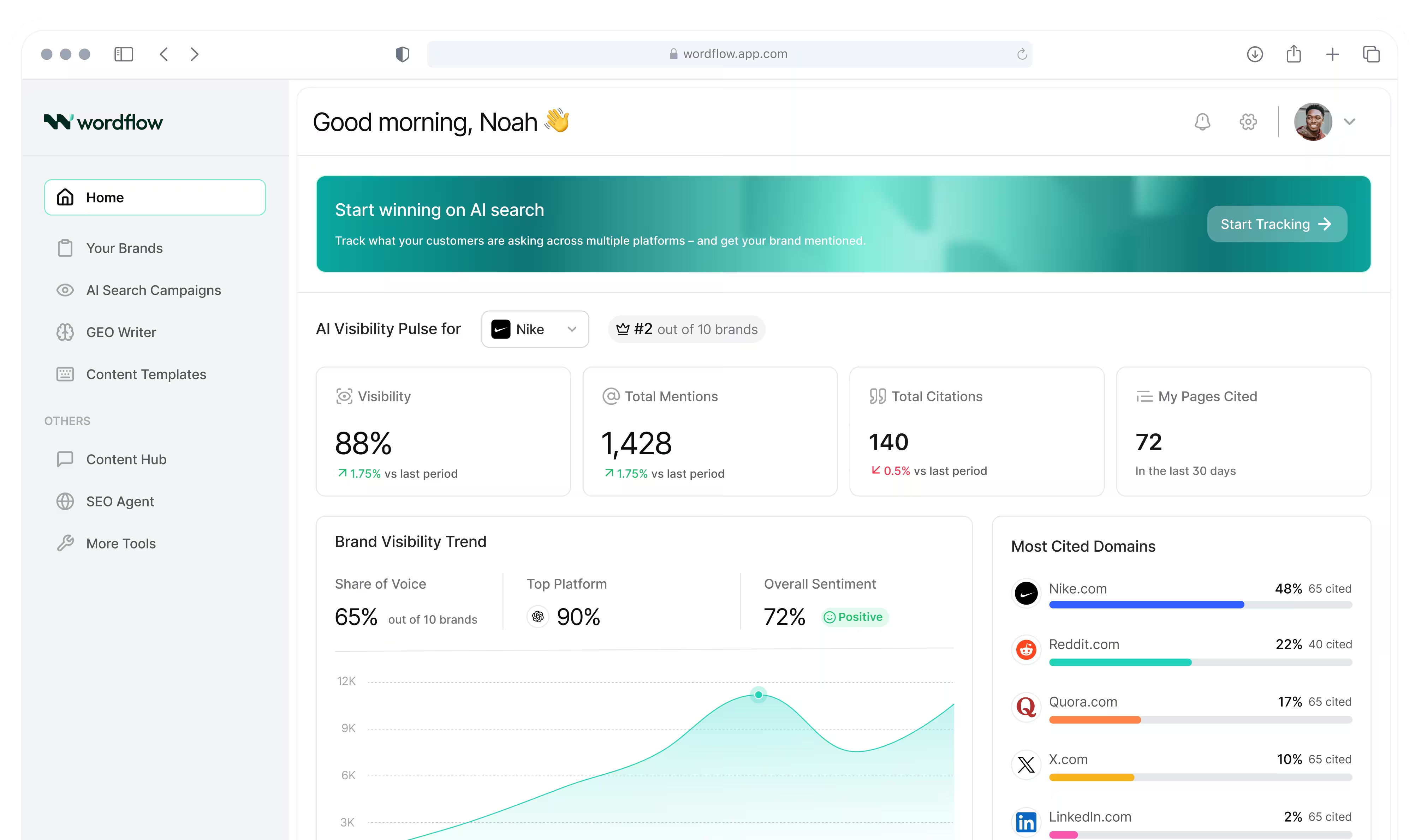
Semrush is one of the best-known SEO tools in the world, but its AI search tracking is an add-on: the AI Visibility Toolkit costs $99 a month per domain for 25 prompts (Semrush). Teams that want more AI engines, deeper analysis or help acting on the results are now looking at tools built for AI search from the start.
We work on AI search every day. Our team tracks how 11 AI engines talk about brands, for ourselves and for clients in finance, logistics, e-commerce and B2B software. So we compared five AI search tools, Wordflow included, on the same eight criteria. Here’s the short version:
- Wordflow: best for turning AI search tracking into action
- Peec AI: best for daily tracking and deep source analysis
- Profound: best for large enterprises running AI marketing at scale
- Otterly.ai: best for small teams on a budget
- Scrunch: best for optimising how AI agents experience your website
There’s no single best Semrush alternative, only the best one for your team, budget and goals. So rather than rank the tools, we show what each is built for.
How we compared the tools
We scored every tool on the eight things we look at when we choose AI search tools for clients. Use them as your own checklist:
- AI engines on each plan. Which engines the plan you’d buy includes, not just which the tool supports, including Chinese engines if you sell to Chinese-speaking buyers.
- Tracking frequency. Daily data shows short-term swings; weekly data shows the trend with less noise.
- Mentions or recommendations. Whether it shows when AI recommends you, hedges (‘it’s good, but…’) or describes you wrongly.
- Sources and citations. Whether it shows which pages and sites AI relies on.
- Help acting on the results. Recommendations, task lists or agents that turn data into fixes.
- Content creation. Whether it helps you write the content that gets cited.
- People and support. Users included, and whether expert help is available.
- Price and trial. Entry price, what it buys, and whether you can try it first.
Facts for the other four come from each company’s own pages, checked on 10 November 2026.
Wordflow: best for turning AI search tracking into action
Wordflow tracks how AI engines talk about your brand, then helps you fix what’s holding you back, all in one place. It’s built for marketing teams, agencies and enterprises in any market.
At a glance: up to 11 AI engines, weekly tracking (daily on Enterprise), unlimited users, no seat limits. Starter from US$99 a month with a 14-day free trial.
Why choose Wordflow
- It goes from tracking to fixing. Most AI search tools stop at the data. Wordflow covers the whole loop: check a question with the Prompt Scanner, track it every week in an AI Search Campaign, see what’s holding you back in Insights, turn it into tasks in the Action Hub, and create the content with GEO Writer.
- It tells you which stage is breaking, not just a score. Every campaign measures whether AI finds you (Found), describes you correctly (Understood), cites your pages (Cited) and recommends you over competitors (Recommended), then shows the first stage that’s failing.
- It measures recommendations, not just mentions. Wordflow shows how often AI recommends you outright, how often it hedges with a ‘but’, and how accurately each engine tells your brand story against the Brand Profile you set.
- It covers Western and Chinese AI engines. Pro and Agency track all 11: ChatGPT, Google AI Overviews, Gemini, Perplexity, Grok, Claude, DeepSeek, Qwen, Doubao, Yuanbao and Kimi.
- No seat limits. Plans are account-based, so your whole team, or every client at an agency, works in the same account.
- Content and governance are built in. GEO Writer creates cite-ready content to your Brand Profiles and compliance checklists, and the MCP connector brings your data into Claude.
- Expert help when you want it. FlowManaged adds our AI search specialists: FlowLaunch to set up, FlowGEO for a monthly action plan, and FlowContent to write and publish for you.
What to consider with Wordflow
- Tracking is weekly on Starter, Pro and Agency (daily on Enterprise). Weekly data is steadier, but the other tools here track daily as standard.
- Starter covers 6 engines. All 11, including the Chinese ones, come with Pro and Agency.
- Microsoft Copilot and Google AI Mode aren’t tracked yet.
- Prices are in US dollars, with a 14-day free trial (card required).
Pricing: Starter US$99 a month (100 prompts, 6 engines, 10 Prompt Scanner runs), Pro US$299 (300 prompts, 11 engines, 25 scans), Agency US$699 (750 prompts, 11 engines, 50 scans), Enterprise custom. Save 20% with annual billing (Wordflow pricing).
Peec AI: best for daily tracking and deep source analysis
Peec AI is a Berlin-based AI search analytics platform for marketing teams and SEO agencies. It launched in early 2025, and its site says it’s trusted by more than 4,000 brands and agencies, including Zalando, Squarespace, Hugo Boss, Wix and TUI, and agencies such as Seer Interactive and Mindshare (Peec AI).
At a glance: 3 AI engines on standard plans (up to 13 on Enterprise) · daily tracking · unlimited users · Starter €85, Pro €205, Advanced €425 a month, Enterprise custom (Peec AI pricing)
Why choose Peec AI
- Daily tracking on every plan, with unlimited users, competitors and languages.
- Deep source analysis. Peec AI shows which domains and URLs AI engines retrieve and cite, classifies each source (competitor, editorial, reference or user-generated), and finds sources that mention competitors but not you.
- It flags what AI holds against you. Its ‘Objections’ feature groups the recurring arguments AI raises against your brand (Pro and above), and it fact-checks AI answers against facts you set.
- Built for e-commerce and local too. Product-level (SKU) tracking from a Shopify or Google Merchant Center catalogue, plus Local GEO.
- Agent analytics and integrations. A crawlability audit covers 40+ AI bots, plus AI referral tracking, Looker Studio, an API and an MCP connector.
What to consider with Peec AI
- Standard plans track 3 AI engines, chosen from ChatGPT, Google AI Mode, Google AI Overviews, Copilot, Gemini and Naver AI. Claude, Perplexity, Grok, DeepSeek and Qwen are listed only on Enterprise.
- Fewer prompts for the price: 50 on Starter, 150 on Pro and 350 on Advanced, with 1 country on Starter and 3 on Pro and Advanced.
- No managed service is listed. Recommended actions and agent actions point the way, but your own team or agency does the work.
How it compares with Wordflow: Peec AI is one of the strongest analytics tools in the category, especially for daily data and shopping tracking. Wordflow tracks more engines on its mid-tier plan (all 11 on Pro, including five Chinese engines, against 3 on Peec AI’s standard plans), gives more prompts for the price, measures recommendation rate and story accuracy as separate stages, and adds GEO Writer and FlowManaged to do the work.
Profound: best for large enterprises running AI marketing at scale
Profound is an enterprise AI search platform. It says it serves more than 1,000 enterprise brands, including Comcast, The Estée Lauder Companies, Walmart, Zoom, Ramp and Figma, and over a third of the Fortune 100 (Profound). It started as an AI search analytics platform and is now built around ‘AI Marketer’, an AI agent that analyses AI answers, spots opportunities and sends sub-agents to research, write and report.
At a glance: up to 9 answer engines · daily tracking · unlimited seats · free 7-day trial, then Enterprise pricing on request (Profound pricing)
Why choose Profound
- Built for the largest brands. Tailored prompt tracking, custom languages and regions, SSO/SAML and SOC 2 compliance, and a dedicated specialist with a 24-hour SLA on request.
- AI Marketer and Agents. Reusable agent workflows refresh stale content, find earned media opportunities and run competitive analysis, guided by a Context Manager that holds your brand’s positioning.
- Paid and organic together. Its Ads Studio helps teams build and manage AI search ad campaigns across OpenAI, Google and Meta’s ad managers.
- Wide coverage and analytics: up to 9 engines including Google AI Mode, Claude and DeepSeek, Agent Analytics for AI-sourced traffic, and Prompt Volumes to estimate what people ask AI.
What to consider with Profound
- There’s no self-serve paid plan. Beyond a free trial (50 prompts run daily for 7 days, on ChatGPT, Gemini and Google AI Overviews), pricing is custom and starts with a demo.
- AI Marketer runs on credits, so you’ll need to estimate how much your team will use.
- It’s designed for large enterprises, so smaller brands may pay for more than they need.
How it compares with Wordflow: Profound suits very large enterprises that want AI agents and AI search ads in one platform. Wordflow offers published, self-serve plans from US$99 a month, tracks Grok and four more Chinese engines (Qwen, Doubao, Yuanbao and Kimi) as standard on Pro, and pairs the software with human specialists through FlowManaged for teams that want people, not just agents, doing the work.
Otterly.ai: best for small teams on a budget
Otterly.ai is an Austrian AI search monitoring startup that launched in 2024 and set out to become ‘what Semrush or Ahrefs are for SEO, but in the AI search space’ (TechCrunch). It has since partnered with Semrush and was named a Gartner Cool Vendor in AI in Marketing in 2025. It positions itself as a tool to use alongside your SEO platform (Otterly.ai).
At a glance: 4 AI engines included (plus paid add-ons) · daily tracking · unlimited team members · Lite US$29, Standard US$189, Premium US$489 a month · 7-day free trial
Why choose Otterly.ai
- The lowest entry price. Lite is US$29 a month for 15 prompts tracked daily, with unlimited team members and brand reports.
- Room to grow. Standard (US$189 a month) covers 100 prompts with unlimited workspaces, which suits agencies with several clients.
- GEO URL audits. Every plan includes page audits with recommendations on what to fix: 1,000 a month on Lite, 5,000 on Standard and 10,000 on Premium.
- Agency-friendly and connected. 50+ countries, an Agency Partner programme with branded reports, and Looker Studio, API and MCP access from Standard.
What to consider with Otterly.ai
- Four engines are included: ChatGPT, Google AI Overviews, Perplexity and Copilot. Google AI Mode and Gemini are paid add-ons ($9 to $149 a month depending on plan), and so is Claude ($29 to $439).
- It’s focused on monitoring and audits. Content creation and a managed service aren’t part of its published plans.
How it compares with Wordflow: Otterly.ai is the cheapest way to start monitoring AI search. Wordflow costs more at entry level, but Starter includes 100 prompts and Gemini, Grok and Claude without add-ons, Pro adds the five Chinese engines, and every plan goes further after the data with the Action Hub, GEO Writer and the option of FlowManaged.
Scrunch: best for optimising how AI agents experience your website
Scrunch calls itself an AI customer experience platform. It was acquired by Sitecore, the digital experience platform, in June 2026, and continues to run as its own platform alongside Sitecore’s content tools (Sitecore). It says it’s trusted by more than 500 brands and agencies.
Its standout is its Agent Experience Platform (AXP), which delivers your content in a format AI agents can read and use, without changing what human visitors see. In an Akamai analysis published by Sitecore, AXP-enabled pages appeared 364% more often in AI answers to non-branded prompts than comparable pages without it.
At a glance: 4 AI engines on Core (9 on Enterprise) · 5 users on Core · Core US$250 a month for 125 prompts, Enterprise custom · 7-day free trial (Scrunch pricing)
Why choose Scrunch
- AI agent experience. AXP and Agent Pages make your site easy for AI agents to read and use, which matters as more research and buying is done by AI on a buyer’s behalf.
- Site analysis built in. AI site audits, AI agent and bot traffic tracking, and page optimisations show how AI crawlers use your site.
- Monitoring with funnel context, including citations and sources, sentiment, funnel stages, query fan-out and AI search trends.
What to consider with Scrunch
- Core covers 4 engines: ChatGPT, Perplexity, Google AI Overviews and Copilot. Claude, Gemini, Google AI Mode, Grok and Meta AI are on Enterprise only.
- Its standout feature is Enterprise only. AXP, API access, expanded models and strategy calls all sit on the custom Enterprise plan.
- Core has limits: 1 brand, 1 country, 5 competitors, 5 users and ‘basic’ content generation.
How it compares with Wordflow: Scrunch suits larger brands optimising how AI agents read their site, especially Sitecore customers. Wordflow tracks more engines on lower-priced plans (6 on Starter at US$99, 11 on Pro at US$299, against 4 on Scrunch Core at US$250), has no seat limits, measures recommendations and story accuracy, and includes GEO Writer and the Action Hub on every plan.
How the 5 tools compare, and which fits your brand
Wordflow is the only tool of the five that pairs software with a managed service, and the only one that lists Doubao, Yuanbao and Kimi.
Prices and features from each vendor’s website, checked 10 November 2026. ‘Not stated’ means we couldn’t find it on the vendor’s pricing page.
Which fits your brand?
- You want to know what to fix and get it done: Wordflow.
- You want daily data and deep source analysis: Peec AI.
- You’re a large enterprise that wants custom contracts and AI agents: Profound.
- You want the cheapest way to start tracking: Otterly.ai.
- Your priority is how AI agents use your website: Scrunch.
- You mainly need traditional SEO, with some AI tracking on top: stay with Semrush and its AI Visibility Toolkit.
How Wordflow helps brands get found in AI search
Most teams don’t need another dashboard. They need to know why AI leaves them out, and someone to fix it. Wordflow is built for that step, in four moves:
- Test. Run your key buyer questions through the Prompt Scanner to see which brands AI names, recommends and cites.
- Track. Turn those questions into an AI Search Campaign that runs every week across up to 11 AI engines, so you see trends, not one-off answers.
- Diagnose. Find the first stage that’s breaking: AI can’t find you, describes you wrongly, doesn’t cite you, or won’t recommend you.
- Fix. Turn Insights into tasks in the Action Hub, write cite-ready content with GEO Writer to your brand and compliance rules, or hand the work to FlowManaged’s specialists.
Start a 14-day free trial or book a demo and we’ll show you where your brand stands in AI search.
Frequently asked questions
What is an AI search tool?
An AI search tool tracks how AI engines such as ChatGPT, Gemini and Perplexity talk about your brand. It runs the questions your buyers ask, records which brands each engine names and recommends, and shows which pages it cites. The better tools also show you what to fix.
Which AI search tool tracks the most AI engines?
On published plans, Wordflow tracks 11 engines on Pro and Agency, including five Chinese engines. Peec AI lists up to 13 and Profound and Scrunch up to 9, but only on their Enterprise plans. Otterly.ai includes 4, with others as paid add-ons.
Which AI search tool is best for agencies?
Look for no per-seat costs, multiple brands and client-ready reports. Wordflow’s Agency plan covers 750 prompts across all 11 engines with no seat limits, plus FlowManaged for extra hands. Otterly.ai’s Agency Partner programme and Peec AI’s agency pricing are also built for agencies.
Do I still need Semrush if I use an AI search tool?
Often, yes. Semrush is strong for traditional SEO, such as keyword research and backlinks. Many teams keep it for Google and use a dedicated AI search tool for ChatGPT, Gemini, Perplexity and other AI engines.
Which AI search tool tracks Chinese AI engines?
Wordflow tracks five Chinese engines on Pro and Agency: DeepSeek, Qwen, Doubao, Yuanbao and Kimi. Peec AI lists DeepSeek and Qwen on Enterprise, and Profound lists DeepSeek.
Read More
GEO vs. SEO in 2026: what actually changes (and what doesn’t)
Learn how GEO (Generative Engine Optimization) differs from traditional SEO in 2026.
How AI workflows are changing the way marketing works
Discover how a unified AI workspace transforms fragmented marketing operations into a seamless, efficient, and collaborative environment for better results.
How to measure your brand's presence inside AI conversations
AI visibility doesn't have to be a guessing game. Here's what the data tells us so far.
Your buyers trust AI answers.
Make them pick you.
See what AI engines say about your brand today, and what it takes to be the brand they recommend.