October 26, 2026
AI search engine optimisation for enterprises: how to plan, prioritise and assign the work
AI search isn't just a marketing job. Learn which teams fix each stage of AI visibility, how to pick one focus for 90 days and how to assign the work.
In most large organisations, AI search gets handed to marketing. Marketing publishes more content, checks a few AI answers and wonders why little changes. The reason is simple: most of what decides whether AI recommends your brand isn't controlled by marketing at all.
AI search engine optimisation (also called AI SEO or GEO) is the work of making sure AI tools can read your content, describe your brand correctly, see you mentioned on websites they trust and feel confident recommending you. In an enterprise, those four jobs sit with different teams: web and IT, brand and product, communications and partnerships, customer experience and sales.
This guide shows which team can fix what, how to pick one focus for the next 90 days so those teams pull in the same direction, and how to assign the work so someone owns the result. You don't need any background in AI SEO to follow along.
Why AI search isn't just a marketing job
Search for how to improve AI visibility and you'll find checklists with 30 or more tasks. Look closely and they span half the organisation. Crawler settings belong to IT. Product pages belong to product and web teams. Press coverage belongs to communications. Reviews come from customer experience.
That matters because AI relies heavily on what happens outside your marketing channels. AirOps analysed 21,311 brand mentions in AI answers and found that 85% came from third-party websites, with only 13.2% coming from brands' own sites (AirOps, 2025). Review sites, partner directories, news coverage and forums all shape what AI says about you, and marketing rarely controls them alone.
When AI search is treated as marketing's side project, two things happen. Either marketing tries to do everything and stalls, or every team starts its own AI initiative and nobody can say which one worked. A good AI search strategy, sometimes called a GEO strategy, avoids both. It brings the right teams in, gives them one shared focus, and makes one person accountable for the result.
The four stages AI goes through before it recommends you
Before AI suggests a brand, four things have to be true. It has to be able to read your content, describe you correctly, see you mentioned on websites it trusts, and feel confident enough to recommend you. At Wordflow, we call these stages Found, Understood, Cited and Recommended. We explain the framework in more detail in our guide to getting AI to recommend your brand, not just mention it.
Each stage depends on the one before it, so work on a later stage is mostly wasted while an earlier one is broken. Press coverage can't help much if AI can't read the pages it links to. Reviews can't help if AI has put you in the wrong category. That's why the order matters, and why the teams involved need to work on the same stage at the same time. If you're not sure which stage is holding you back, our guide Does AI Know Your Business Exists? shows how to check each one in order.
How each team can fix each stage
Each stage is usually led by one or two teams, with others contributing. Here's who does what, and the number that shows whether it's working.
Found: can AI read your content?
Led by: SEO, web and development. The number to watch: visibility score, or how often you appear across a fixed set of buyer questions.
- Web and development make sure key pages load their content without relying on scripts, and fix anything that stops crawlers reaching them. When Vercel studied close to a billion monthly AI crawler requests, it found none of the major crawlers ran JavaScript (Vercel, 2024).
- SEO audits the 20 or so pages that matter most, and checks how the site tells AI crawlers what they may read.
- IT and security check that firewall and bot-protection settings aren't blocking AI crawlers by accident. Cloudflare, which handles traffic for around 20% of the web, now asks every new domain whether to allow AI crawlers and blocks those without permission by default (Cloudflare, 2025).
- Product keeps pricing and product information on public pages, not locked inside PDFs, logins or forms.
Understood: does AI describe you correctly?
Led by: brand, product marketing and content. The number to watch: brand-story accuracy, or how often AI describes you correctly.
- Brand approves one clear description of who you are and who you serve, and makes sure it's used everywhere.
- Product marketing keeps product names, features and pricing consistent, and retires pages for products you no longer sell.
- Content updates the about page, FAQs and key directory listings to match.
- Regional teams make sure the description holds up in every market and language, not just the head-office version.
- Legal and compliance agree a fast sign-off path, so an approved description doesn't sit in a queue for months.
Cited: do trusted websites mention you?
Led by: communications, content and partnerships. The number to watch: citation share, or how often AI's answers draw on websites that mention you.
- Communications and PR find the publications AI cites most for your category, then pitch them stories, data and expert commentary.
- Content creates original research and data that those publications want to reference.
- Partnerships make sure you're listed accurately on partner directories, integration pages and industry association sites.
- Leadership and subject experts take part in interviews, podcasts and bylined articles that build independent evidence.
Recommended: is AI confident enough to suggest you?
Led by: customer experience, community and communications. The number to watch: recommendation rate, or how often AI suggests you over competitors, and how often it adds a caveat.
- Customer experience asks for detailed reviews straight after a clear customer win, when people have real detail to share.
- Community teams take part in forums and groups where buyers compare options, answering questions honestly.
- Sales and support share the objections they hear most, because the 'but' AI attaches to your brand often mirrors them.
- Product fixes the real weakness behind a caveat that keeps coming up, rather than hoping content can talk around it.
Marketing still has an important role in every stage. It usually owns the plan, the tracking and the reporting, and it coordinates the teams doing the work. But it can't fix every stage alone.
How to choose one AI SEO focus for the next 90 days
With this many teams involved, the temptation is to start work on all four stages at once. Don't. Pick the first stage in the chain that's clearly broken, and make it the organisation's single focus for the next 90 days. Ninety days is a good planning cycle for AI search engine optimisation: long enough to finish real work, and short enough to keep several teams aligned. Expect 2 to 3 weeks of tracking before drawing conclusions, and 4 to 8 weeks before changes start to show in AI answers.
Then turn the focus into something measurable:
- Use the stage's number as your main KPI (key performance indicator). There are plenty of GEO KPIs you could report, but pick one number, not ten.
- Record where you stand today using a fixed set of 20 to 30 buyer questions, and keep those questions the same for the whole 90 days. SparkToro found that AI rarely gives the same list of brands twice, and concluded that the share of answers a brand appears in, measured across many questions, is a more reliable thing to track than any single 'ranking' (SparkToro, 2026).
- Set a target, not an activity. 'Increase how often trusted websites mention us from 8% to 15%' is a target. 'Publish three articles' is an action. Research by psychologists Edwin Locke and Gary Latham found that specific, difficult goals consistently led to higher performance than simply urging people to do their best (Locke and Latham, 2002).
If you operate in several markets, check each one separately. AI can describe you accurately in Australia and get you wrong in Hong Kong, especially when buyers ask in another language. Markets can have different priority stages, but each should still have only one.
Who owns what: four roles that keep teams working as one
Once the focus is clear, the biggest risk in enterprise AI search engine optimisation isn't too little effort. It's effort that nobody owns. Four roles keep it on track.
One accountable lead. One person owns the whole plan: the priority stage, the target, the tracking and the reporting. This is often the head of SEO, digital or brand marketing. They don't do all the work. Their job is to make sure the right teams do the right work in the right order.
Action owners in the teams that do the work. Each action sits with the team that has the skills, and with one named person in that team, not a department. Their time belongs to their own team's priorities, so agree actions with their managers in the first two weeks. Agencies can deliver much of the work, but an internal owner still answers for each action.
A small working group. The lead, the action owners and one person from each market meet monthly for 30 minutes: what's done, what's blocked and what the number did. Ideas outside the current focus go on a list for the next cycle.
A senior sponsor. Cross-team work often stalls on approvals: legal sign-off, budget for research, time from developers. A sponsor at leadership level clears those blocks and receives a one-page update that leads with the result, not the activity.
Keep the plan small. Two or three focused actions for your priority stage over 90 days is usually enough, even in a large organisation. Every action needs a clear deliverable, one named owner, a deadline and the number it should move.
A real-world example: one plan, three teams
Harbourline, a fictional travel group selling in Australia, Singapore and Hong Kong, checks each market. In Australia and Singapore, AI describes Harbourline accurately, but the travel review websites and publications AI cites most barely mention it. That's a Cited problem. In Hong Kong, AI still uses the name the company traded under before a rebrand. That's an Understood problem.
Mei, head of digital marketing, is the accountable lead, and the plan has three actions:
- Australia and Singapore (target: citation share from 9% to 15%). Claim and complete Harbourline's profiles on the three most-cited review websites, and send review requests after every completed trip. Owner: Daniel, customer experience manager. Deadline: week 6.
- Australia and Singapore (same target). Pitch original data on how families in both markets book holidays to the two travel publications AI cites most. Owner: Aisha, communications lead, with the PR agency drafting the pitch. Deadline: week 10.
- Hong Kong (target: brand-story accuracy from 55% to 80%). Approve one current brand description in English and Traditional Chinese, and update it across the website and key directory listings. Owner: Kelvin, Hong Kong marketing manager, with legal sign-off. Deadline: week 4.
Only one of those three owners sits in central marketing. That's the point. There's no website redesign, new blog series or social campaign this cycle. Those things matter, but they won't move these numbers.
How to know when it's time to move on to the next focus
At day 90, the working group compares each number with where it started. Move on when the evidence says the weak link has moved:
- You've hit your target, and it has held across at least two checks. If Harbourline's Hong Kong accuracy reaches 82% and stays there, that market moves on to the next stage, and a different set of teams takes the lead.
- The number has levelled off and the evidence points further along the chain. If citation share in Australia reaches 14% but AI still names Harbourline with a 'but' attached, the constraint has shifted to Recommended, and customer experience moves to the front.
Stay where you are if the number is moving but hasn't reached the target. Go back a stage if something earlier breaks, such as a website migration that blocks AI crawlers again. Don't move on just because 90 days have passed.
That's how to improve AI search visibility across a large organisation: one stage at a time, the right teams on each one, one owner for every action, and a clear decision every 90 days.
How Wordflow helps enterprise teams work from the same numbers
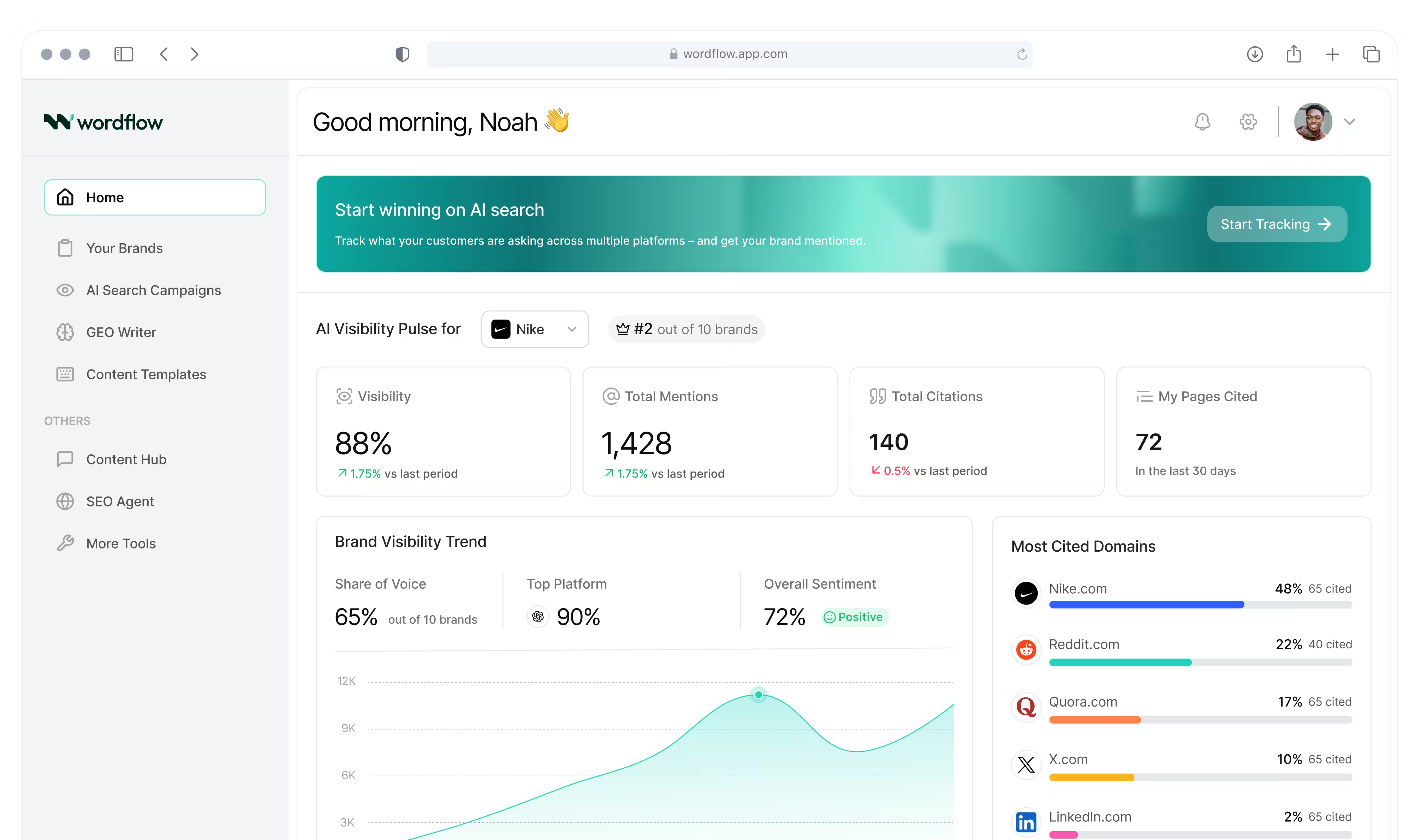
When several teams share responsibility for AI search engine optimisation, they need to see the same evidence. Wordflow tracks your buyer questions across up to 12 AI engines, depending on your plan, including the major Chinese AI assistants that matter for buyers in Hong Kong and beyond. Questions stay fixed and are tracked weekly, so your starting point is recorded from day one and every team sees the same trend.
Each stage maps to a part of Wordflow, which makes it easy to hand the right evidence to the right team. The AI readiness check gives web and IT a list of technical barriers. Brand Narrative campaigns show brand and product marketing where AI's description drifts from your approved story. Pages and Citations shows communications and partnerships exactly which websites AI relies on. Brand Comparison campaigns show customer experience how often AI recommends you and where it hedges. You can run campaigns for each market and language, so regional teams get their own read.
The GEO Action Hub turns what Wordflow finds into a prioritised list of actions, giving the working group one list to choose from. When content is the right fix, GEO Writer helps create it, and TransCreate adapts it for your markets in more than 40 languages.
Ready to bring your teams onto one AI search plan? Book a demo and we'll help you find your priority stage, or start with Wordflow. To learn the full approach to AI SEO at your own pace, download the AI Visibility Playbook.
Read More
Artifical Intelligence.
Real Results
Ready to transform how you market? Start your unlimited free trial today and experience the advantage Wordflow brings to your results.